At one hotel in Side, a standard room with a direct sea view measures 22–24 m², while the same standard with a side sea view measures 24–26 m². The room with the weaker view is the bigger one. A room's name tells you very little: the size, the beds and what you'll see from the balcony are all in the description, and that's the part to read.
This guide covers everything you'll find in a room description when booking a holiday from Poland: categories from standard to suite, the codes SGL, DBL, TWN and EXB, view labels, and resort formats such as swim-up rooms. For each one we say who it suits and who will be disappointed, and we look at what travelling alone really costs.
- Couple on a week's all-inclusive → Room categories, Room views
- Travelling with a baby under two → Family rooms
- Family of four with school-age children → Family rooms, Resort room types
- Three adults sharing → Occupancy codes
- Friends or colleagues who want separate beds → Double or twin
- Travelling alone → Solo travel
- You want the sea from your balcony → Room views
- Honeymoon → Swim-up rooms and villas
- Booking a hotel in Poland → Stars and room size
What Superior, Deluxe and Suite actually tell you
Most hotels rank their rooms in the same order: Standard, Superior, Deluxe, Junior Suite, Suite. That order only holds within a single hotel, though. No international rule says how many square metres a Superior must have or what separates it from a Deluxe.
| Category | Typical size | What you usually get | Separate bedroom |
|---|---|---|---|
| Economy / Single | 10–15 m² | the basics, often no balcony | no |
| Standard | 15–25 m² | one large bed or two singles, bathroom, air conditioning | no |
| Superior | 25–35 m² | more space, often a balcony or a better view | no |
| Deluxe | 25–35 m² | newer furnishings, better soundproofing, a seating area | no |
| Junior Suite | 35–45 m² | a lounge area in the same room as the bed | usually not |
| Suite | 45–80 m² | bedroom and living room in separate rooms | yes |
These sizes are market averages, not a standard. One hotel's Deluxe can easily be smaller than the Superior next door. At the same Side hotel, a Superior with a sea view is 30–32 m², while its swim-up rooms are around 40 m² and have a sofa for a third guest. Above the regular suite, some hotels also sell Presidential or Royal Suites of 100–300 m², with several bedrooms, a study and sometimes a private terrace with a pool.
So compare rooms on four lines of the description: size, how many adults and children the room takes, the type of extra bed and the view. Comparing category names between hotels gets you nowhere.
“Apartment” can mislead too. In aparthotels and city hotels it usually means a flat with a kitchen and a washing machine, cleaned less often than a hotel room – not a luxury suite.
Executive and Club rooms turn up mostly in city and chain hotels. What sets them apart from a Superior is less the floor area than the extras: a proper desk, faster internet and access to a separate lounge serving breakfast and drinks. On a beach holiday that supplement rarely pays off.
Who is it for
A standard room is enough if you spend the day on the beach and by the pool and only come back to change and sleep. A Superior or Junior Suite makes sense for couples staying 10–14 nights and for families who need space for an extra bed. Not worth it: a suite for a week's all-inclusive at a resort, where you pay for a living room you'll use for an hour a day.
Reading the occupancy codes: SGL, DBL, TWN and TRPL
The second half of a room name tells you how many people sleep there and on what. The codes are the same across tour operators:
- SGL – single room with one single bed;
- DBL – double room with one large bed;
- TWN – twin room with two separate beds;
- TRPL – triple room, usually with an extra bed added;
- QDPL – quadruple room.
A double bed in a hotel is usually 140–160 cm wide, a queen around 160 cm and a king 180–200 cm. Polish regulations require a double bed in a hotel to be at least 140×200 cm; abroad, that rule doesn't apply.
Treat DBL or TWN on a booking as a request rather than a guarantee. Rooms are allocated at check-in, and you may find two beds where you expected one. Some hotels have twin/double convertible beds that can be pushed together and joined with a shared mattress, so it's worth asking at reception.
A triple rarely has three full-size beds. More often it's a double room with a rollaway or sofa bed added. At the Side hotel mentioned above, the 22–24 m² sea-view standard takes three adults, with the third on a rollaway.
Who is it for
Twin rooms suit friends, colleagues, a parent with a grown-up son or daughter – anyone who sleeps better apart. Not worth it for three adults sharing a standard room with a rollaway for more than a couple of nights: someone spends the whole trip on a folding bed, and 22 m² won't fit three open suitcases.
Which room works for a family
Book with children and a few more codes appear, each one affecting the price:
- ADL – adult, from age 12 in most hotels;
- CHD – child, usually aged 2–12, often split into 2–6 and 6–12;
- INF – infant under 2, usually without a bed of their own;
- EXB – extra bed.
The hotel sets the age limits, not the tour operator. A 12-year-old may count as a child in one hotel and as an adult in another, and the price of the whole holiday shifts accordingly.
Families have several options. A family room sleeps three or four, is larger than a standard and sometimes has two areas or two rooms. Those areas may be separated by a door – or only by an arch or a sliding partition, so check the photos if your children go to bed earlier than you do. Connecting rooms are two separate rooms with a door between them. A duplex puts the bedroom on a mezzanine or upper level, and a family suite gives parents a bedroom of their own.
The key line in the description is maximum occupancy: how many adults and children the room takes. If your family doesn't fit, the search simply won't show that room. Cots for babies are provided on request, so add one to the booking rather than asking at reception.
Who is it for
A family room or duplex suits a family of four with children over six who need their own beds. Connecting rooms work well for parents of teenagers: everyone gets a bathroom, and the door between the rooms can be shut. Not worth it: ten nights for a family of four in a standard room with an extra bed. Four people in 22–25 m² with one bathroom means a queue every morning.
Sea view, side sea view and land view compared
Hotels price the view separately and add it to the room name. These are the labels you'll see most often:
| Label | Code | What you see | Watch out for |
|---|---|---|---|
| Sea View | SV | the sea straight ahead | on low floors, trees may block it |
| Side / Partial Sea View | SSV, PSV | the sea off to one side or partly hidden | often visible only from the balcony |
| Land View | LV | anything that isn't the sea | a garden, a car park or the next building |
| Garden / Pool View | GV, PV | the gardens or the pool | daytime entertainment music by the pool |
| Inside / No View | – | a courtyard, corridor or service area | the cheapest, but sometimes no daylight |
A hotel may sell the same standard room at several prices depending on the view. The Side hotel from our example lists a standard with sea view, side sea view, land view and sea-and-pool view separately, each also available for single use.
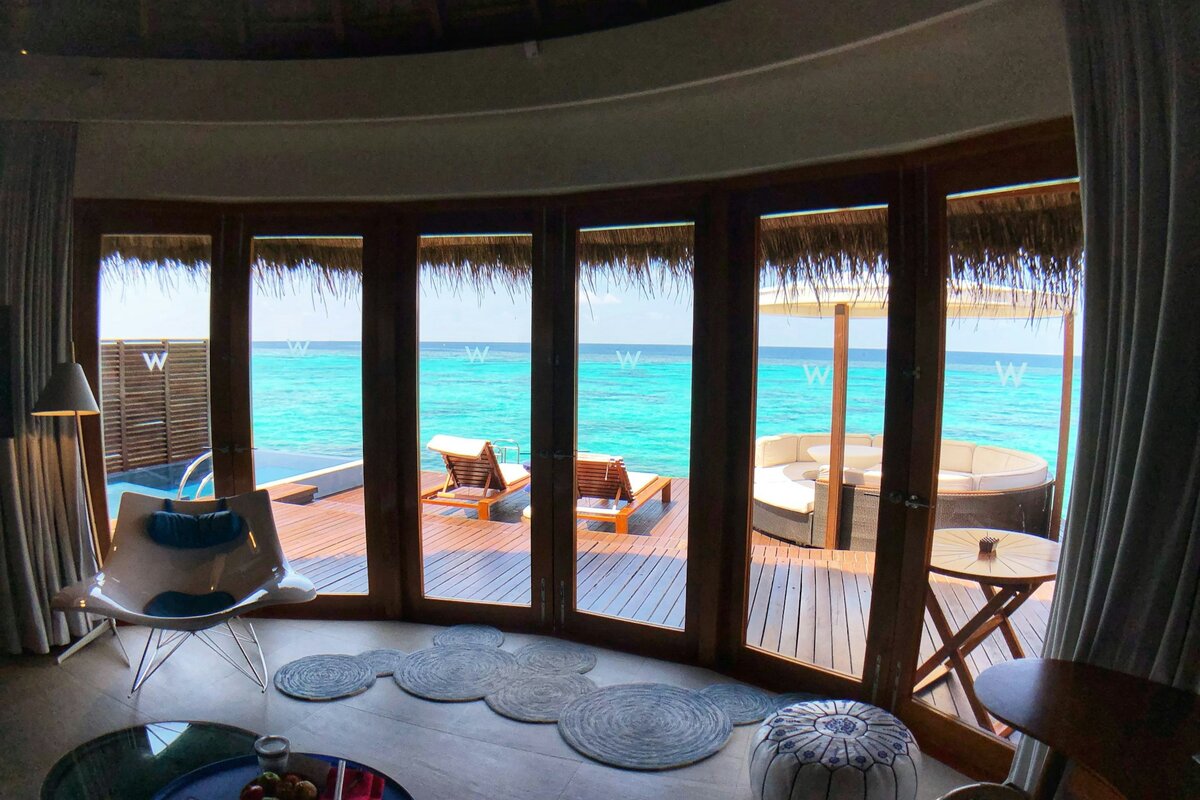
Land view commits the hotel to nothing. Behind those two words could be a palm garden or a car park. If the view matters to you, look at guest photos in reviews and at the site plan: they show which side of the building faces the entrance road and which faces the gardens.
City hotels use City View for rooms facing the street and Courtyard View for those overlooking an inner courtyard. The first is noisier; the second is quieter but darker.
Who is it for
A sea view is worth it for couples on a short break who want coffee on the balcony and a sunset over the water. Not worth it if you're on the beach by nine and back for dinner: for most of the day, nobody is looking at that view.
Rooms you'll only find at resorts
At large hotels on the Mediterranean and the Red Sea, or in the Maldives, the room name also tells you where the room sits within the resort.
Swim-up rooms are on the ground floor, with a terrace that steps straight into the pool. The pool is shared by several rooms, sometimes a dozen or more, and runs along the building like a canal. There's less privacy than the photos suggest: your neighbours swim right past your terrace.
Bungalows and villas are separate units with their own entrance and terrace, sometimes with a private pool or hot tub. In the Maldives the choice is usually between a beach villa that opens onto the sand and a water villa built on stilts over the lagoon.

MB stands for main building. Large resorts often spread rooms across several blocks, some of them a long walk from the beach and the restaurants. In that case the block name, or a label such as Club or Garden, says more about the room than its category does.
ROH, or run of the house, means the hotel chooses your room. You find out which one at check-in. It costs less, but you have no say over the beds, the view or the floor.
Larger hotels also have accessible rooms for wheelchair users, with wider doors, level-access showers, grab rails in the bathroom and lower switches. There are only a few in each hotel, so book early and confirm directly with the hotel.
What to do
- Add your requests to the booking: one large bed, a higher floor, a cot. The hotel isn't bound by them, but staff will see them when allocating rooms.
- At check-in, before taking the key, ask which block the room is in and how far it is from the beach.
- Photograph the room as soon as you walk in, before you unpack. The pictures help if the room doesn't match the description.
- If your windows face the entertainment stage or a service entrance, ask to move on the first day, while rooms are still free.
- In connecting rooms, check straight away that the inner door opens from both sides; sometimes reception has to unlock it.
Who is it for
Swim-up rooms suit couples without children who like an early swim before the pool fills up. A water villa is the classic choice for a Maldives honeymoon. Not worth it: a swim-up room with a toddler who can't swim, because the terrace drops straight into the water and is almost impossible to make safe. ROH is also a poor bet for a family that needs a set number of beds.
The real cost of a room on your own
Holiday prices are almost always quoted per person sharing a double. Travelling alone, you have two options: a single room, or a double sold to one guest, listed as DBL single use.
Not every hotel has singles, and where they exist they're the smallest rooms in the building, often without a balcony or a view. DBL single use is an ordinary double room, and you pay more than half its price.
Single room: the smallest in the hotel, not available everywhere
DBL single use: a full double room at a higher price per person
Supplement in Türkiye: typically 40–50%, up to 100% in some hotels
Round trips: without the supplement, you may share with another traveller
There's no fixed rule. The British consumer group Which? found that solo travellers with TUI paid on average 47% more than someone travelling as a pair. The Polish operator Itaka explains it simply: prices are calculated per place in a double room, and a room for one costs the hotel almost as much.
Round trips work differently. If you don't pay the single supplement, you're placed in a twin with another traveller of the same sex. Some hotels also offer Single with Child rooms for one adult and a child, and the search shows them when you enter one adult and one child.
Who is it for
DBL single use suits someone staying more than a week who wants a proper bed and a balcony. Not worth it: travelling alone at the height of July and August if your dates are flexible. The supplement is a percentage of the year's highest prices, so in PLN it's at its largest.
Stars measure the hotel, not the room
Star ratings won't tell you the room size either. Poland's regulation on hotel facilities sets a minimum floor area for each category, and an amendment in force since 15 September 2026 lets hotels go up to 10% below those figures.
| Hotel category | Single room | Double room | Double room with 10% allowance |
|---|---|---|---|
| 3* | 10 m² | 14 m² | 12.6 m² |
| 4* | 12 m² | 16 m² | 14.4 m² |
| 5* | 14 m² | 18 m² | 16.2 m² |
Since the amendment, an entrance hall and a loggia may count towards the floor area. A minibar is no longer compulsory in a four-star hotel if there's a 24-hour self-service shop on site, while Wi-Fi is now required in every category. Hotels that already held a category have until 15 March 2027 to comply.
None of this applies abroad. Each country sets its own criteria, and the Polish consumer authority UOKiK warns that a three-star hotel abroad may match the standard of a Polish one-star. Stars describe the hotel as a whole: its restaurant, reception and pool. The room description tells you about the room.
One practical point for residents of Poland: enter your name in the booking exactly as it appears in the passport you'll travel on, because hotels abroad check you in against it. A Polish residence card doesn't replace a passport, and whether you need a visa for your destination depends on your citizenship, not on your status in Poland.
Checklist before booking:
- Find the room size in the description, not just the category name.
- Check how many adults and children the room takes and whether the extra bed is a rollaway or a sofa bed.
- Check the age up to which the hotel counts a child as a child.
- Decode the view: SV, SSV and LV are three prices and three different views.
- Find out which building the room is in and how far it is from the beach.
- Match the name on the booking to your passport, and the room type on the voucher to the one you chose.
Common mistakes:
- Choosing by category name. One hotel's Superior can be smaller than another's standard.
- Mixing up double and twin. Double means one large bed; twin means two separate ones.
- Taking side sea view for sea view. With SSV the sea is off to one side or partly hidden, often visible only from the balcony.
- Booking ROH with children. A room of the hotel's choosing doesn't guarantee the number of beds.
- Comparing stars across countries. Five stars in Egypt and five stars in Poland are different sets of requirements.
- Waiting until you're home to complain. If the room isn't what you booked, report it at the hotel and to the tour operator's representative straight away; UOKiK treats this as grounds for a complaint.
So which room should you book?
For a couple on a week's all-inclusive, a well-described standard or Superior is usually all you need.
Families of four should look for a family room, a duplex or connecting rooms, and check the hotel’s age limits for children first. Three adults are better off with two rooms or a family room than with a standard and a rollaway. Solo travellers choose between a cramped single and a pricier DBL single use, and on a round trip they can avoid the supplement by agreeing to share. Sea views and swim-up rooms are worth paying for only if you actually spend time in your room.
One practical tip:
When comparing two hotels, put the room size and maximum occupancy side by side and ignore the category names. Often the cheaper standard at one hotel turns out roomier than the Superior at the other. On travelato.pl you can compare offers from many hotels in one place before choosing a room.













 Holidays


 Last minute
 Hotels


 Blog