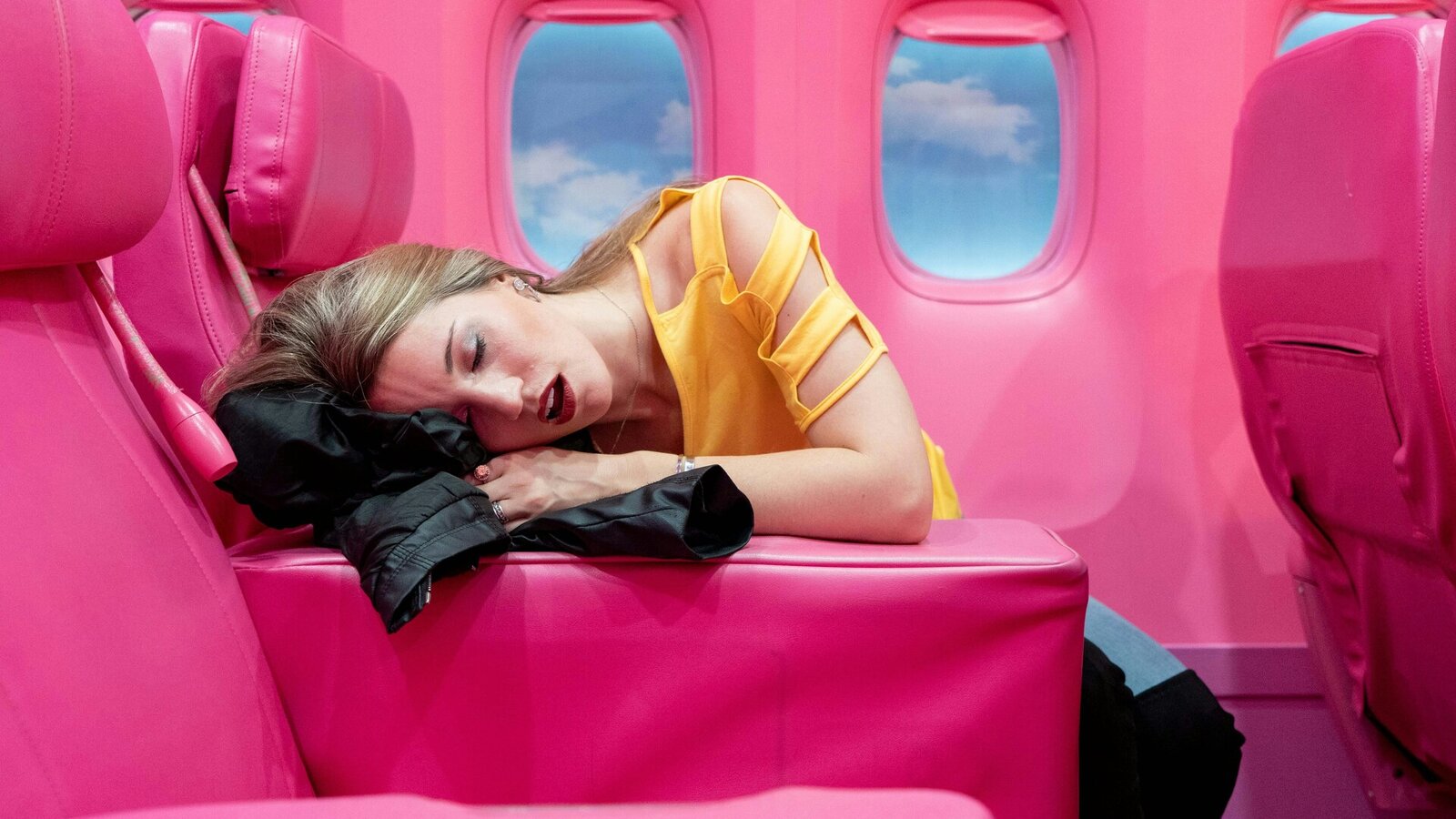
During the cruise, cabin pressure is held at the equivalent of 1,800–2,400 metres above sea level, humidity falls to 10–20 per cent against the 30–60 you get indoors, and the engines produce 80–85 decibels — roughly a busy street outside your window. The seat was designed around safety regulations rather than around a sleeping spine. Failing to sleep on board is therefore not bad luck but the result of four specific conditions, and every one of them can be prepared for before departure.
What this guide covers: what those hours at altitude do to the body, which seat genuinely helps, what fits into hand luggage, the order of actions that gets you to sleep in a seat, two relaxation techniques worth practising at home, and the rules that apply to flights over six hours, to children and to passengers with a raised risk of thrombosis.
- You want to know why sleep will not come → What a few hours at cruising altitude do to the body
- You are still choosing the flight and the seat → Before you board: flight, seat, food
- You are packing hand luggage → Five items that change the outcome
- You are already in the seat → The bedtime routine, step by step
- You would rather not reach for tablets → Two techniques that have to be practised at home
- You are flying long haul or with a child → Long flights, children and the thrombosis question
- You have one specific question → The questions that come up most often
What a few hours at cruising altitude do to the body
An uncomfortable seat is only one reason, and not the most important one. Several things act on the body at once in flight.
- Cabin pressure. Even modern aircraft hold the cabin not at sea level but at a pressure equivalent to 1,800–2,400 metres. Blood oxygen saturation drops to around 90 per cent, which a healthy passenger tolerates without difficulty, though it adds to tiredness and keeps sleep shallow.
- Dry air. Humidity in the cabin runs at 10–20 per cent, drier than most deserts, while indoors we are used to 30–60. The nose and throat dry out, and you surface more often.
- Engine noise. Noise reaches 80–85 decibels and stays there for hours. A constant drone makes the deeper stages of sleep harder to reach.
- Vibration and a tight seat. Even slight vibration of the fuselage keeps the muscles from letting go, and the space between seats rules out any natural sleeping position.
- Time zones. Cross several of them and your body clock stops matching the one on the wall, first in the air and then for the first days after arrival.
Four of those five can be worked on: noise can be cut, dry air offset by drinking water, posture improved with the seat and a pillow, and the body clock shifted before you leave home. The rest of this guide is about how.
Cabin pressure: equivalent to 1,800–2,400 m; blood oxygen saturation around 90 per cent
Humidity: 10–20 per cent against 30–60 indoors
Noise: 80–85 decibels throughout the cruise
Cabin air: completely replaced every two to three minutes
Before you board: flight, seat, food
Most of the work is done at the booking stage, not in the seat
A night flight hands you conditions no daytime departure can match: dimmed cabin lights, quiet neighbours and a body that expects to sleep at that hour anyway. Choosing between a morning and an evening departure, with sleep in mind, the evening one wins.
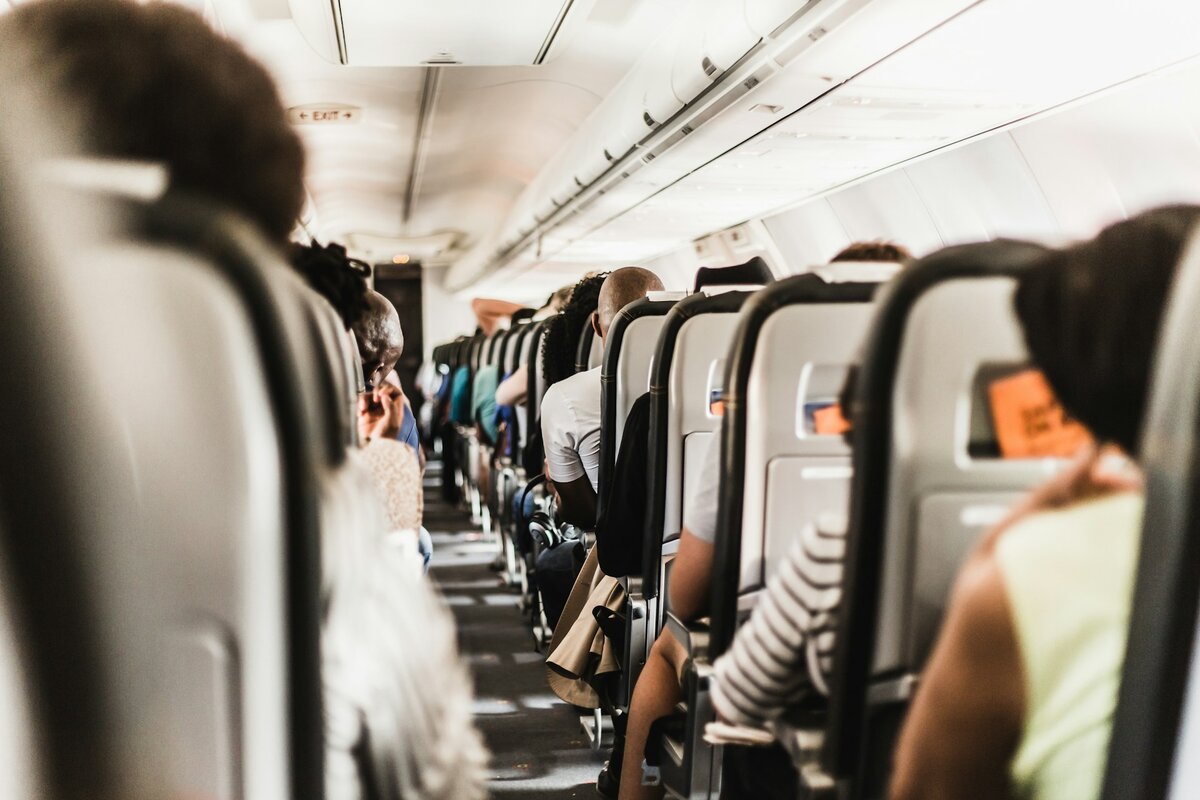
Then comes the seat. The gap between a window seat and one by the toilets is wider than the gap between most airlines.
| Seat | How well it works for sleeping |
|---|---|
| Window | The best option: something to lean your head on and nobody asking to get past |
| Over the wing | Turbulence is felt least here — a sensible compromise when the window seat has gone |
| Emergency exit row | Plenty of legroom, but on some aircraft the seat back does not recline |
| Aisle | More noise, the drinks trolley, and neighbours getting up during the night |
| Next to the toilets or the galley | The worst choice: movement, light and conversation for the whole flight |
Coffee and alcohol are the two mistakes made before the aircraft even leaves the stand. Caffeine stays in the body for six to eight hours and blocks the receptors behind drowsiness, so an espresso in the terminal works against you for half the flight. Alcohol relaxes for the first half hour and then breaks sleep into pieces while deepening the dehydration that dry cabin air has already started. Water and a caffeine-free herbal tea do the job better.
A heavy meal keeps you awake as well; rice, a salad or a banana — which brings magnesium and tryptophan with it — sit far more lightly. A few minutes of stretching before boarding loosens the muscles that are about to spend hours in one position. And if you are crossing several time zones, start moving your bedtime by half an hour a day two or three days before departure — that single habit does more against jet lag than anything you can do on board.
Five items that change the outcome
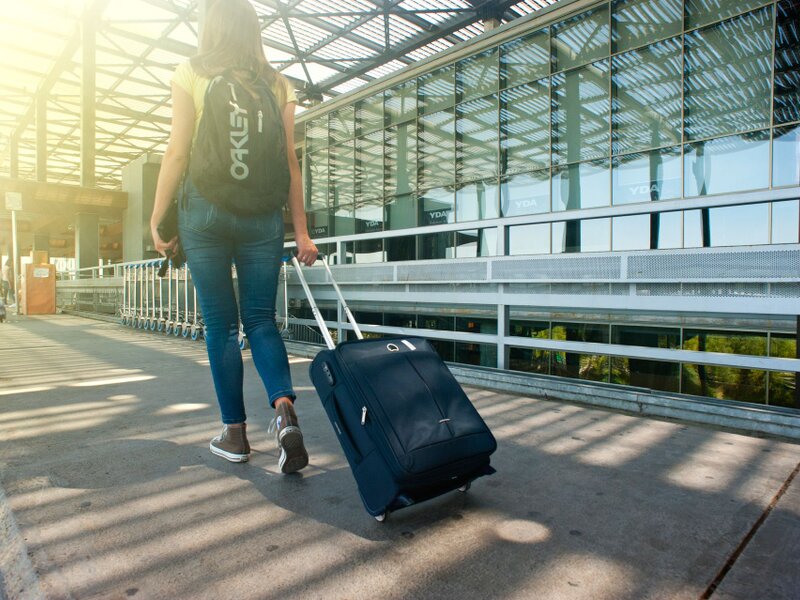
The whole kit fits in one pouch and weighs under a kilogram. Without it the result is left to chance: your neighbour, the lighting, the announcements from the flight deck.
- Eye mask. A contoured model keeps the fabric off your eyelids and lets you blink underneath while still blocking the light completely. Silk and bamboo fibre are the materials that stay comfortable over several hours against the skin.
- Neck pillow. An inflatable one packs down to nothing and lets you adjust the firmness; memory foam holds the head more securely. A clasp at the front stops the pillow sliding every time you turn.
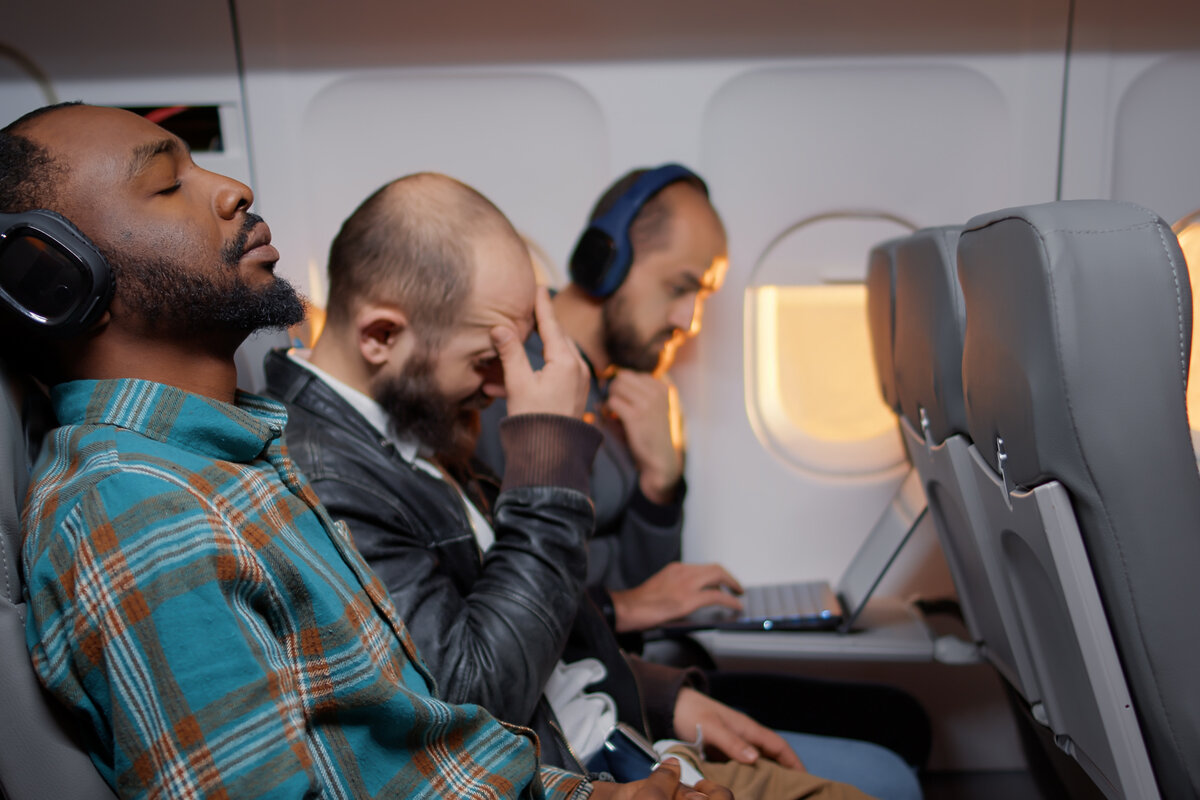
- Earplugs or noise-cancelling headphones. At 80–85 decibels, taking the background down by even fifteen turns shallow dozing into real sleep. Against conversation, white noise or slow music at 60–80 beats per minute works better than silence.
- Blanket or a large scarf. Cabin temperature drops noticeably at night, and warmth is one of the signals the body reads as bedtime.
- Compression socks. They limit swelling and blood pooling in the legs during hours of stillness, which makes them worth packing on any flight over four hours, even without a history of vein trouble.
Who is it for
For anyone flying further than the Mediterranean: on the eight to eleven hours it takes to reach Zanzibar, the Maldives or Thailand from Poland, the kit pays for itself on the first trip. Not worth it to carry the full pouch to Crete or Antalya — with two or three hours in the air you will manage half a nap at best, and most of the kit will stay unopened.
The bedtime routine, step by step
The brain responds to a familiar sequence of actions rather than to altitude. The more closely you reproduce your own evening on board, the sooner it takes the hint.
- Repeat what you normally do at home. Brush your teeth in the lavatory, change, put the mask on, wrap yourself in the blanket — the same order as at home works ten kilometres up as well.
- Change into something loose. Soft trousers leave no pressure on the waist or legs, and over several hours small pressures add up into general irritation.
- Put the screens away half an hour before. Blue light from a phone or the seat-back display suppresses melatonin. A paper book, or simply closed eyes, prepares you better than one more episode.
- Recline the seat. Upright, the spine stays under tension; even fifteen degrees takes load off the lower back and neck.
- Fasten the belt over the blanket. A visible belt means nobody wakes you during a turbulence check.
- Settle however suits you. Some travellers tuck their legs up, others turn towards the window. There is no correct position — what counts is that no muscle group is working.
- Put on a quiet sound. White noise, classical music or a recorded meditation drown out the internal monologue more effectively than silence under earplugs.
Two techniques that have to be practised at home
The first comes from Lloyd Bud Winter's book "Relax and Win" and, according to that source, formed part of the training given to United States Navy pilots, who learned to fall asleep in any conditions, including sitting upright and under heavy stress. The same book reports that after six weeks of regular practice the method worked for roughly 96 per cent of those trained. That figure cannot be verified independently today, but progressive muscle relaxation as such is a recognised technique, widely used in work on sleep and anxiety.
You release the body in order, from the top down:
- The face. Close your eyes and let go of the forehead, jaw, tongue and cheeks until the face feels soft.
- The shoulders. Drop them low, as though they were falling of their own accord, then release the neck.
- The arms, one at a time. Biceps first, then forearm and hand — and the same on the other side.
- The legs. Thigh, calf, foot; one leg, then the other.
- Ten seconds of nothing. Hold ten seconds without a thought; if that fails, repeat "don't think" silently instead.
The second technique is 4-7-8 breathing, popularised by the American doctor Andrew Weil. Deliberately slowing the breath lowers the heart rate and engages the parasympathetic nervous system, the one responsible for rest. Breathe in through the nose for a count of four, hold for seven, breathe out through the mouth for eight, and run three or four cycles. The two methods combine well: release the body first, then bring the heart rate down with the breathing.
Who is it for
For travellers who would rather not use sleeping tablets and have a few weeks before departure to learn the sequence at home. Not worth it to arrive at the airport assuming either method will work first time in the air: tried for the first time in a seat, with engine noise and pre-departure nerves, it usually ends in frustration, and frustration pushes sleep further away.
Long flights, children and the thrombosis question
Flights over six hours
On long-haul routes, get up and walk every ninety minutes to two hours, even at the cost of an interrupted nap. In the seat, ankle rotations and flexing the feet do most of the work; the exercise takes a minute and can be done with your eyes shut.
Thrombosis: what the numbers say
World Health Organization research found that the risk of venous thromboembolism roughly doubles after four hours spent immobile — on a plane, but equally in a train or a car. The absolute risk stays low, at about one in six thousand journeys, and remains raised for around four weeks after the flight. More care is needed by passengers with vein disease, anyone recently operated on, pregnant travellers and those taking oral contraceptives, people carrying extra weight, and both very tall and very short passengers, whom the seat does not fit. In those cases the class of compression sock and any further precautions are settled with a doctor before departure rather than at the gate.
Children and babies
Children fall asleep in what they recognise: their own pyjamas, the blanket from their cot, one familiar soft toy. The principle is identical to the adult routine. For babies, take-off and landing are a good moment to feed or offer a dummy, since sucking equalises the pressure in the ears and calms them at the same time.
Using a CPAP machine on board
Passengers with sleep apnoea who use a CPAP machine should confirm the airline's rules on carrying and operating the device in the cabin well in advance, and bring their own battery or an adapter for the seat socket. This is not something that can be arranged at check-in.
Moving the legs: every 90–120 minutes on long-haul flights
Compression socks: from four hours of flying
Thrombosis risk: about 1 in 6,000 journeys, raised for up to four weeks afterwards
CPAP: notify the airline before departure, bring your own power supply
Who is it for
For long-haul passengers and for parents of small children — the two groups for whom preparation matters more than any breathing exercise. Not worth it to board a long flight planning to sleep straight through if you fall into a higher-risk group for thrombosis: eight unbroken hours without moving is a worse idea in that case than several shorter naps with a walk in between.
The questions that come up most often
Which seat on a plane is best for sleeping?
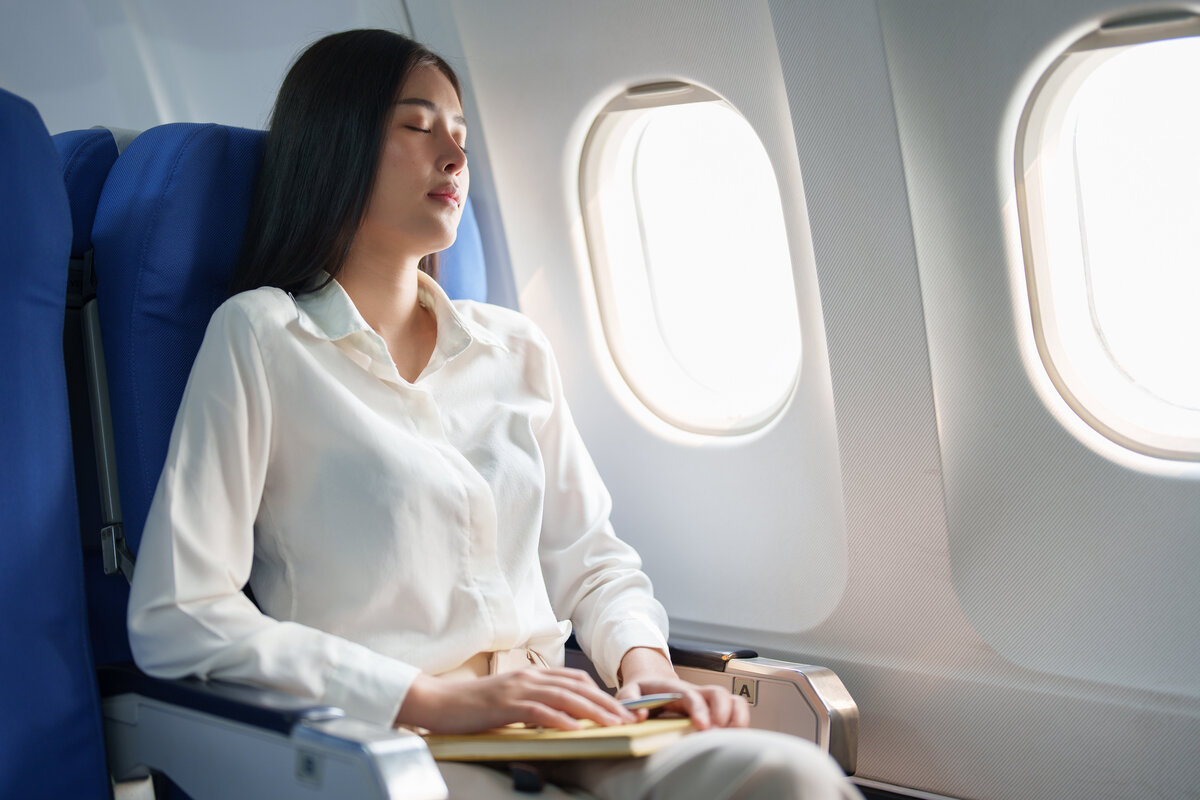
The window: you have something to lean on and nobody asks you to move during the night. Second best is a seat over the wing, where turbulence is felt least. Leave the aisle, the galley and the rows by the toilets to other people.
Can I have a coffee before sleeping on board?
Better not. Caffeine stays in the body for six to eight hours and blocks the receptors behind drowsiness, so a cup in the terminal shows up in the first half of the flight. If you intend to sleep in the air, stop drinking it several hours before departure.
Are sleeping tablets safe on a flight?
Not without a doctor's advice. Sleeping tablets can cause dizziness, confusion and dehydration, and in an emergency on board there is a risk of not waking in time. That decision belongs to a doctor, not to a passenger packing hand luggage.
Why should you not sleep with your legs crossed?
Crossed legs restrict circulation and raise the risk of deep vein thrombosis, particularly during hours of stillness. Keep your feet parallel and slightly forward instead.
How does the pilots' technique get you to sleep in two minutes?
You release the body in order from the face downwards — shoulders, arms, legs — and then hold ten seconds without thinking. It improves with practice, so run the first attempts at home rather than in a seat at take-off.
What if sleep simply will not come?
Do not force it. Annoyance at your own wakefulness raises the heart rate and pushes sleep further off. Close your eyes, follow your breathing or put on a meditation; rest without sleep still reduces the fatigue a flight leaves behind.
Do compression socks help you fall asleep?
Not directly. They reduce swelling and blood pooling in the legs, which makes hours in a seat physically easier, and that in turn makes sleep more likely.
What belongs in hand luggage?
An eye mask, a neck pillow, earplugs or noise-cancelling headphones, a blanket, and compression socks for anything over four hours. All of it fits into a single pouch.
Check before departure:
- Seat booked by the window or over the wing, not beside the toilets
- Sleep kit packed separately, at the top of your hand luggage
- Last coffee at least several hours before you plan to sleep
- A bottle of water bought after security
- Compression socks packed if the flight runs over four hours
- Bedtime shifted for two or three days beforehand if you are crossing several time zones
Common mistakes:
- Coffee or alcohol shortly before sleeping on board. Caffeine is still working six to eight hours later, and alcohol fragments sleep while deepening dehydration.
- Staying on the phone until the last minute. Blue light suppresses melatonin exactly when you need it most.
- Sleeping bolt upright. Even fifteen degrees of recline takes more load off the spine than most passengers expect.
- Crossed legs for the whole flight. Restricted circulation and a higher thrombosis risk on anything over four hours.
- An unfamiliar sleeping tablet taken as a precaution. Side effects and the risk of not waking in an emergency settle the question.
- Talking to your neighbour right before trying to sleep. Even a pleasant exchange wakes the brain up; the mask and earplugs, put on early, solve it without awkwardness.
Sleeping on a plane comes down to preparation
Cabin pressure is fixed, and almost everything else can be arranged before take-off.
A night flight, a window seat, the kit in your hand luggage, water instead of coffee and your own evening sequence repeated in the seat cover most of the problem. What remains is progressive muscle relaxation or 4-7-8 breathing, both of which need a few weeks of practice at home and both of which fail when tried for the first time at cruising altitude. Treat flights over six hours separately: there, movement every ninety minutes takes priority over uninterrupted sleep.
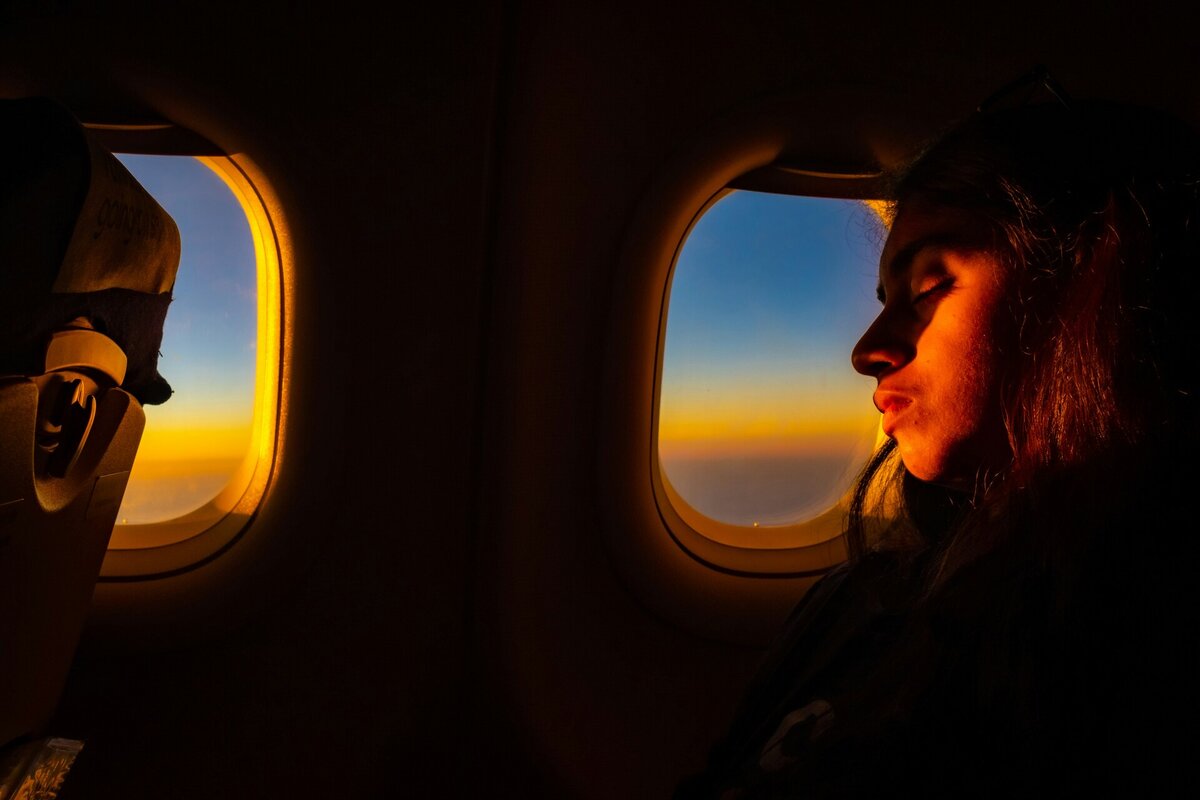
One last piece of advice:
Keep the mask, earplugs, pillow and blanket in a separate pouch at the very top of your hand luggage. Five seconds to pull it out, instead of ten minutes of digging through the overhead locker, means the routine starts when your body is ready for it rather than a quarter of an hour later.
- Why Can't You Smoke on a Plane
- Airline Baggage Rules
- Damaged Baggage at the Airport
- Laptop in Carry-On Luggage
- How to Carry Alcohol on a Plane
- What's Banned on a Plane
- Charter vs Scheduled Flight
- Cosmetics in Hand Luggage
- What to Pack for a Beach Holiday with Kids
- Travel Medicine Kit
- A Razor in Your Carry-On Luggage




 Holidays


 Last minute
 Hotels


 Blog