
The most common reason passengers don't get compensated for damaged baggage isn't the airline refusing — it's their own mistake in the first few minutes after landing. Someone picks up a dented suitcase off the belt, gets frustrated, and walks out of the arrivals area — and in doing so gives up the evidence they need: proving the damage happened during the flight rather than afterwards becomes far harder once you've left the airport. A damaged baggage claim also comes with a strict deadline — under international rules, just 7 days to file a written complaint — and most passengers only learn this once it's too late. We've put together the complete process for 2026 : what to do in the first few minutes at the airport, which documents to gather, how much compensation you can realistically expect under the Montreal Convention, and where to turn if the airline refuses or drags out its response.
Quick navigation — jump straight to the section you need:
- First steps at the airport → what to do right after landing
- The PIR report → what it is and why it matters
- Documents needed for compensation → the full list
- Claim deadlines → the most common reason for refusal
- How much you can get → Montreal Convention limits
- What compensation doesn't cover → exclusions and caveats
- If the airline refuses → where to go next
- Insurance and bank cards → extra protection
- Protecting your luggage in advance → practical tips
- Frequently asked questions → FAQ on damaged baggage
First steps if your baggage is damaged at the airport
If your suitcase or bag comes off the belt with dented corners, cracks, tears or broken wheels, act immediately, while you're still in the airport's arrivals area.
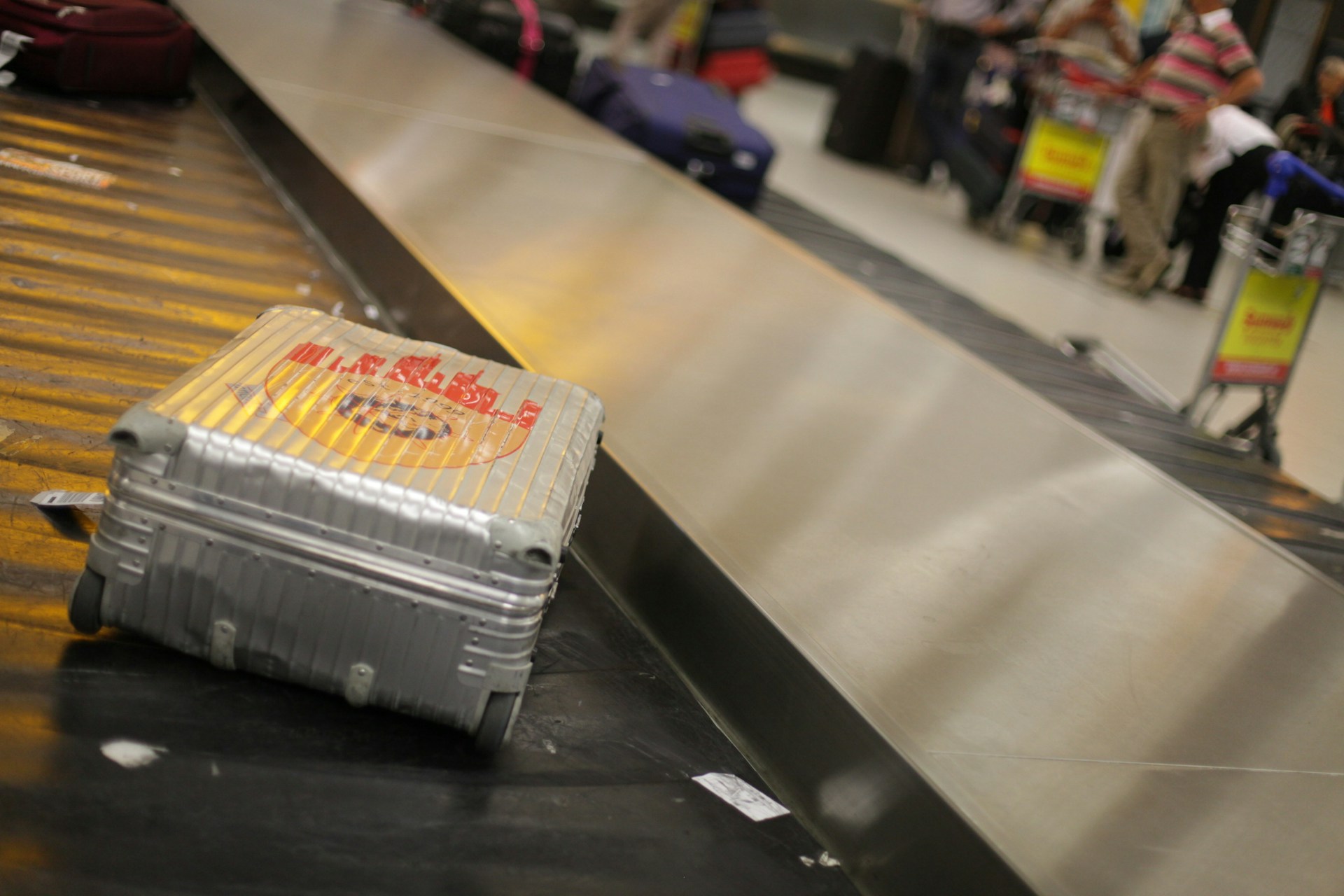
- Don't leave the arrivals area. Once you exit the baggage claim area and pass through passport control or customs on your way out, proving the damage happened during the flight — rather than afterwards — becomes considerably harder. Inspect the suitcase right there at the carousel.
- Go to the Lost&Found desk. Nearly every international airport has one in the baggage claim area. Staff will document the damage, help you fill out a claim form, and issue a specific document — a Property Irregularity Report (PIR).
- Contact your airline's representative. You can do this on the spot at the airport, over the phone, or online through the airline's website. Ask specifically what further steps your carrier requires — rules and internal filing deadlines can vary slightly from the general international standards.
- Photograph the damage on the spot. Take pictures of the suitcase from every angle, a close-up of the damaged area, and if possible a shot including the baggage tag — this is extra evidence to go alongside the PIR report.
Important: even if the Lost&Found desk is closed or there's a long queue, don't leave the arrivals area without at least documenting the damage with photos and finding out where to report it next. Many airlines also accept damaged baggage claims online within the set deadline, but the sooner the damage is documented, the better your chances of being paid.
What a Property Irregularity Report (PIR) is and why it matters
A PIR (Property Irregularity Report) is a standard international document that airports and airlines worldwide use to log baggage problems: damage, delay or loss. It's not a formality — it's the key piece of evidence in your claim. Without a completed PIR, the airline is very likely to refuse compensation, since it has no official confirmation that the damage happened during transport rather than for some other reason.
A PIR typically records: the flight number and departure date, the baggage tag number, a description of the damage, your contact details, and a unique claim reference number you'll use to track the status of your case afterward. Be sure to keep your own copy — it's issued either on paper or sent by email.
What documents you need to claim compensation
To get a damaged baggage claim processed quickly and without extra back-and-forth, it's worth gathering the full set of documents straight away rather than putting it off:
- your ID document, and possibly a copy of it;
- your flight ticket or boarding pass, and possibly copies of those too;
- the baggage tag receipt issued when you checked in your suitcase — don't throw it away as soon as you collect your bag;
- the claim form, which staff at the Lost&Found desk will help you fill out, or which you can submit through the airline's website;
- the PIR damage report;
- receipts for the suitcase or bag itself, and where possible for any valuable contents inside it;
- photos of the damage taken at the airport right after collecting your bag;
- photos of the suitcase's condition before the flight, if you have them — this strengthens the claim separately, by proving the damage occurred specifically during transport;
- a repair estimate, or confirmation that the item can't be repaired — some airlines ask for this as an additional basis for calculating the payout.
Claim deadlines — the most common reason for refusal
International baggage rules set strict deadlines for filing a claim, and missing them is the most common technical reason airlines legally refuse compensation, even when there's no doubt the damage happened. These deadlines are set out in the Montreal Convention of 1999, which governs carrier liability on international flights.
| Situation | Claim deadline |
|---|---|
| Baggage damage | 7 days from receiving the baggage — a written complaint to the airline |
| Delayed baggage delivery | 21 days from the date the baggage was placed at the passenger's disposal |
| Filing a lawsuit, if the airline refuses or doesn't respond | 2 years from the date of arrival — an absolute deadline that cannot be extended |
The seven-day deadline for a damage claim runs from the moment you receive your baggage, not from the moment you notice the problem — so even if you only spot a crack in the shell once you're home, the clock has already started. The practical takeaway is simple: don't put off filing the claim "for later" even once you've got the PIR from the airport — you need to get the final written complaint to the airline within that week.
How much you can get: Montreal Convention limits
There's no way to know the exact compensation amount in advance — every case is assessed individually, based on the proven value of the damage. But there is an upper cap set by international rules.
For international flights, carrier liability is capped by the Montreal Convention of 1999. As of 28 December 2024, the current compensation limit for lost, damaged or delayed baggage is 1,519 SDR (International Monetary Fund Special Drawing Rights) per passenger — roughly €1,800–2,000, or around $2,000–2,100 at current exchange rates (the SDR rate floats daily, so check the exact figure for your specific date on the IMF website).
It's important to understand: this is a ceiling on the carrier's liability, not a guaranteed fixed payout. The airline compensates the documented, actual value of the damage — up to this cap, not automatically the full cap amount. That's exactly why receipts and photos matter so much: without proof of what the suitcase's contents were worth, the airline will most likely offer a minimal standard payout tied to weight or bag type, rather than the real value of what was damaged.
If the contents of your suitcase are worth noticeably more than the standard compensation limit — for example, you're carrying professional equipment or expensive items — many airlines let you register a special declaration of higher value at check-in for an extra fee. This raises the carrier's liability limit specifically for your bag above the standard Montreal Convention cap.
What baggage compensation doesn't cover
It's worth understanding the limits in advance, so you don't expect a payout where the airline has legitimate grounds to refuse:
- Minor damage and normal wear and tear. Many airlines explicitly exclude small scratches, scuffs, stains, cuts to the outer fabric, and broken wheels or handles from compensation — treating these as ordinary wear from transport rather than an event that warrants a payout.
- Valuables and fragile electronics inside the case. Most airlines' conditions of carriage explicitly exclude laptops, cameras, jewellery, cash and fragile items from liability if they were packed in checked luggage rather than carried in the cabin — regardless of whether the suitcase itself was damaged. We've written more about why it's better not to check electronics at all in our article on the rules for flying with a laptop.
- Damage that was never officially documented. If no PIR was filed and the damage wasn't recorded at the airport, proving the connection to the flight becomes extremely difficult, even with receipts and photos in hand.
- Claims filed after the deadline. Technically, an airline is entitled to refuse a claim filed later than 7 days after receiving the baggage, even when there's no question the damage genuinely happened.
What to do if the airline refuses or delays its response
An airline's refusal isn't necessarily the end of the road, if you're confident your claim is legitimate. There's a sequence of steps for escalating further:
- Request a written refusal with reasons. A verbal "no" over the phone isn't enough — ask for an official response by email stating the specific reason for refusal. You'll need this for the next steps.
- Escalate to the airline's higher-level claims department. The first response from customer service isn't always final — most major airlines have a separate passenger claims department with its own review process.
- File a complaint with the national civil aviation authority. For flights from or to Poland, this is the Civil Aviation Authority (Urząd Lotnictwa Cywilnego, ULC), which handles passenger complaints against airlines and can require a carrier to reconsider its decision.
- Use the European Consumer Centre (ECC). For cross-border disputes within the EU, this body helps passengers get a fair hearing on claims against foreign airlines free of charge.
- Go to court as a last resort. Under the Montreal Convention you have 2 years from the date of arrival to do this — usually plenty of time to work through the earlier stages of dispute resolution and only turn to a court once those have proved unsuccessful.
Insurance and bank cards as extra protection
Filing a claim with the airline isn't the only way to recover a loss. It's worth checking two other sources of compensation that often move faster with less paperwork:
- Travel insurance. Many policies include baggage cover for damage, delay or loss — often with a simpler claims process and a faster payout than the airline offers. Check your policy's terms and coverage limits before you travel.
- Bank cards. Some premium debit and credit cards include baggage insurance as part of their benefits package, provided the flight ticket was paid for with that specific card. Check with your bank whether this applies to yours.
One important nuance: you can file a claim with both the airline and your insurer at the same time, but the total compensation from different sources usually shouldn't exceed the actual, documented value of the damage — double coverage beyond your real losses generally isn't provided for under either airline or insurer terms.
How to protect your baggage in advance
- Keep receipts for the suitcase and any valuable contents. Without proof of value, it's hard to get full compensation — keep a receipt for the suitcase itself, and where possible for expensive items inside it, at least in digital form.
- Photograph your baggage before the flight. Pictures of the suitcase from every angle right before check-in are simple, free evidence that there was no damage before the flight. If it contains valuables, photograph those too.
- Don't check valuables or important documents in the hold. Documents, cash, jewellery and electronics — from laptops to cameras — should always go in carry-on: most airlines explicitly exclude these items from baggage liability, even if the suitcase itself is clearly damaged.
- Pack fragile items carefully. If a fragile item still has to go in the hold, wrap it in clothing or bubble wrap and place it in the centre of the suitcase, away from the hard shell and corners.
- Use a distinctive tag or strap on your suitcase. This reduces the risk of mishandling during loading and makes it easier to identify your bag among similar-looking ones on the carousel.
- Consider declaring a higher value at check-in if your suitcase's contents are worth more than the standard compensation limit — a paid option with a number of airlines, but one that raises the carrier's liability cap specifically for your bag.
- Save your airline's contact details on your phone before you fly — the hotline number and online claims page will come in handy if the Lost&Found desk at a particular airport turns out to be closed or overwhelmed.
 Frequently asked questions about damaged baggage
What should I do if I only notice the damage once I'm home?
Contact the airline as quickly as possible — the seven-day deadline for a damage claim runs from the moment you receive your baggage, not from when you spot the problem, so the clock is already running. Without a PIR filed at the airport, proving the connection to the flight will be considerably harder, but many airlines still accept a claim — attach photos of the damage and, if you have them, photos of the suitcase before the flight.
Can I file a claim online if I couldn't get to the Lost&Found desk in time?
Yes, most major airlines accept damaged baggage claims through a form on their official website within the set deadline. But reporting it in person at the airport and getting a PIR remains the more reliable option — it gives you official documentary proof that the problem was recorded immediately.
Will the airline pay for a scratched suitcase?
Not always. Many airlines explicitly exclude minor damage from compensation — small scratches, scuffs, stains and other marks of normal wear during transport. You can generally expect a payout for significant damage: cracks, torn fabric, broken wheels or handles, or a deformed shell.
What if the airline offers too little compensation?
Ask for written justification of the amount offered and compare it against the value of the damage backed up by your receipts. If the offer is clearly too low, you can provide further evidence (a repair estimate, replacement receipts), escalate to the airline's higher-level claims department, and then to the national civil aviation authority or the European Consumer Centre.
Does the Montreal Convention apply to domestic flights?
The Montreal Convention governs international carriage. For domestic flights within a single country, national law and the specific airline's own conditions of carriage usually apply instead, and these can set different compensation limits — it's worth checking your fare's terms before travelling if the flight is domestic.
Do I have to get the suitcase repaired myself if the airline offers to fix it?
Some airlines offer to repair a damaged suitcase instead of paying cash compensation — this is a legitimate resolution if you're happy with the outcome. If a repair isn't possible or the quality is questionable, you can push for cash compensation instead, providing an estimate for the cost of a comparable replacement suitcase.
How long does a damaged baggage claim take to process?
Processing times vary between airlines — from a few days to several weeks, depending on how busy the claims department is and how complete the documents you submitted are. A full set of documents submitted upfront usually speeds things up — incomplete claims are more often sent back with requests for more information.
Does compensation cover items inside the suitcase?
Yes, but with significant limitations. Ordinary clothing and personal items are compensated within the carrier's general liability limit, provided you have supporting receipts. Electronics, jewellery, cash and other valuables are most often explicitly excluded from an airline's liability for the contents of checked baggage — which is exactly why it's recommended to always carry these items in the cabin instead.
Conclusion
Damaged baggage is a solvable problem — if you act quickly and in the right order
Compensation for damaged baggage isn't a rare exception; it's a standard, well-established process, as long as the passenger doesn't leave the arrivals area without a PIR, files within the seven-day deadline, and gathers a full set of documents with receipts and photos. The carrier's liability ceiling on international flights is 1,519 SDR under the Montreal Convention — roughly €1,800–2,000 — but the actual payout is always tied to the documented value of the damage, not paid out automatically at the maximum limit.
Final tip:
The most effective protection isn't arguing with an airline after your suitcase is already broken — it's the few minutes spent before check-in: photograph your bag from every angle, keep the receipt for the suitcase itself, and pack documents, cash and electronics in your carry-on. This won't guarantee your bag stays undamaged, but it makes the process of getting compensated a great deal easier if it does happen.
- What's Banned on a Plane
- Full Rules for Flying With a Laptop
- How to Transport Alcohol on a Plane
- How to Carry a Razor on a Plane







 Holidays


 Last minute


 Hotels


 Blog
Blog