The sea off Djerba reaches 25°C in early October and 23°C at the end of the month — warmer than it is in June. Water slides, the beach bar and restaurants on open terraces, however, run in Tunisian hotels from 1 June to 30 September as standard, and air conditioning is only compulsory until 15 September. The weather stays summery while the hotel has already moved into its quiet season, so the difference between a good week and a disappointing one comes down to the hotel you pick rather than the resort.
What follows: air and sea temperatures for Hammamet, Sousse, Mahdia, Djerba and the north, the list of things a hotel stops providing once the season ends, the gap between the first and the last week of the month, prices for flights from Polish airports, a comparison with Egypt, and the entry rules that apply to different passports.
- You want to swim every day → Sea and air temperatures, resort by resort
- You are travelling with children who expect slides → The hotel season ends two weeks before the weather does
- You are after the lowest price of the month → Which week should you book?
- The beach is a bonus, the desert is the point → October is when the desert becomes bearable
- You are weighing Tunisia against the Red Sea → Tunisia or Egypt — which makes more sense in October?
- You hold a Ukrainian or Belarusian passport → Passports, residence cards and a currency you cannot take home
- You just want the short answer → Book October for the water, not for the poolside programme
Book October for the water, not for the poolside programme
If you want a warm sea without July heat, a desert trip or a course of thalassotherapy, and you are willing to choose a hotel specifically for this month, October delivers. If your holiday is built around slides, entertainment teams and evenings by the pool that run until midnight, the second half of the month will not give you that, and paying more for the hotel does not change it.
Three things shift in October regardless of where you go. Daylight drops to 11 hours and 18 minutes: the sun sets around 18:10 on 1 October and at 17:35 on 31 October. The sea cools gently — from 23–24°C to 21–22°C in Hammamet and Sousse, from 25°C to 23°C off Djerba — but evening air falls to 17–18°C, so a jumper earns its place in the suitcase. Rain returns in the north: Tabarka collects roughly 94 mm across the month, Hammamet 38–40 mm over four to six days, and Douz in the south under ten.
Everything else is decided by two lines in your booking: how far south you fly and which week you choose.
Sea and air temperatures, resort by resort
Four degrees of water separate Tabarka in the north from Zarzis in the south
The sea warms more slowly than the air and cools more slowly too, which is why swimming off the Tunisian coast is warmer in October than in June even though the air is noticeably cooler. The autumn average is 24.1°C at Hammamet and 25.1°C at Djerba.
| Region | Daytime air | Sea | Night | Rainfall |
|---|---|---|---|---|
| Tabarka, Bizerte | +24–25°C | +21–22°C | +15–17°C | about 94 mm |
| Hammamet, Nabeul | +26–27°C | +23–24°C early, +21–22°C late | +17–18°C | 38–40 mm over 4–6 days |
| Sousse, Port El Kantaoui, Monastir | +26–27°C | +23–24°C early, +21–22°C late | +17–18°C | about 35 mm |
| Mahdia | +27°C | +23–24°C | +18°C | about 30 mm |
| Djerba, Zarzis | +27–28°C | +25°C early, +23°C late | +20–22°C | 10–25 mm over 3–4 days |
Thirty years of measurements make October the wettest month of the year in Hammamet, which rarely appears in brochures. That does not mean a grey week: the resort still gets around 220 hours of sunshine in October, more than seven hours a day. It does mean that one or two days of proper rain fall within the norm, so keep a fallback — the medina in Nabeul, a museum, a thalasso session in the hotel.
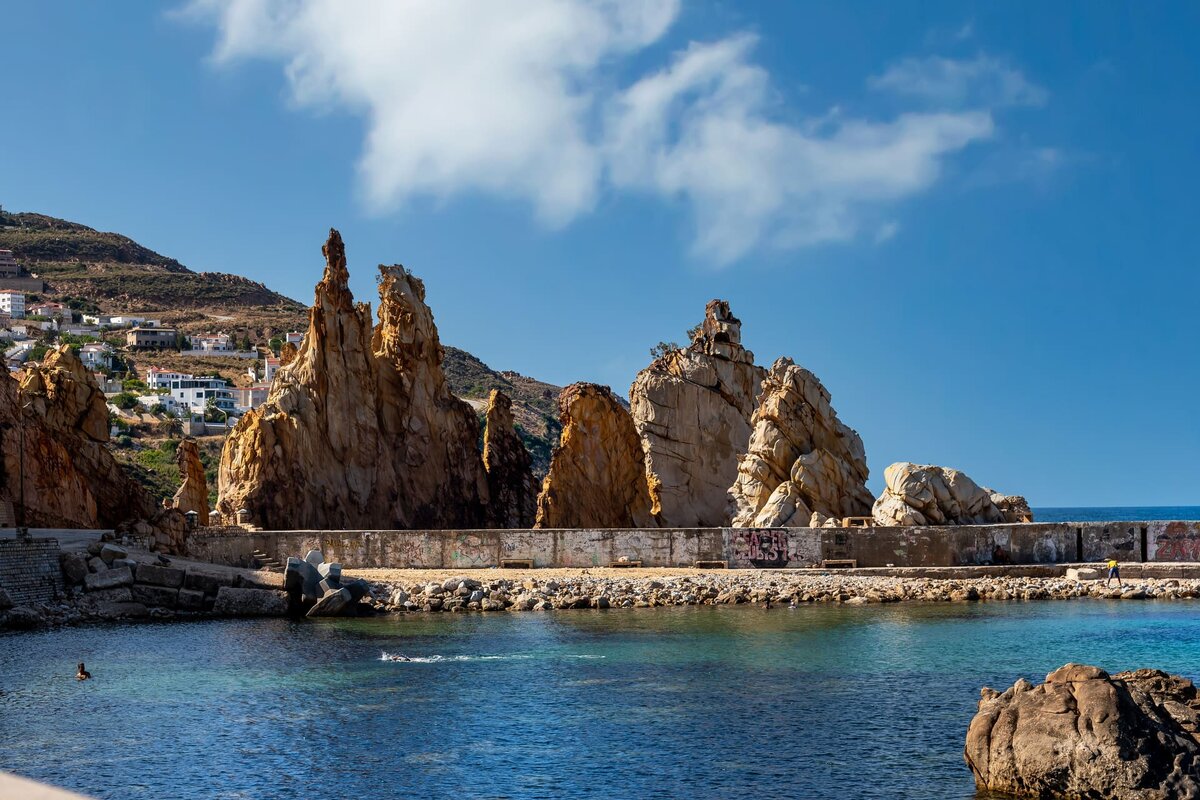
Wind matters as much as water temperature. From mid-month the north-westerly picks up, and the swell it raises on open beaches spoils swimming faster than a two-degree drop ever will. Sheltered bays — Hammamet, Mahdia, the southern shore of Djerba — handle it far better than the exposed stretches between Sousse and Monastir.
Flight from Poland: about 3 hours to Enfidha and Monastir, 3 hours 20 minutes to Djerba
Seven nights for two, all inclusive: roughly 5,500–6,600 PLN in offers from Katowice checked on 14 September
Best time to swim: the first fortnight; on Djerba, the whole month
Transfer: about 45 minutes from Enfidha to Hammamet and to Sousse
Who is it for
For people whose main plan is swimming: Djerba and Zarzis hold their water temperature to the end of the month and get the least rain in the country. Not worth it in the north — Tabarka or Bizerte — if your plan is to lie on a beach: with 21°C water and almost a hundred millimetres of rain, that coast works for divers and walkers instead.
The hotel season ends two weeks before the weather does
This is where most October complaints come from, and all of it can be checked before you pay. Tunisian hotels work to fixed season dates, written into the terms tour operators agree with their local partners, and those dates take no notice of the forecast.
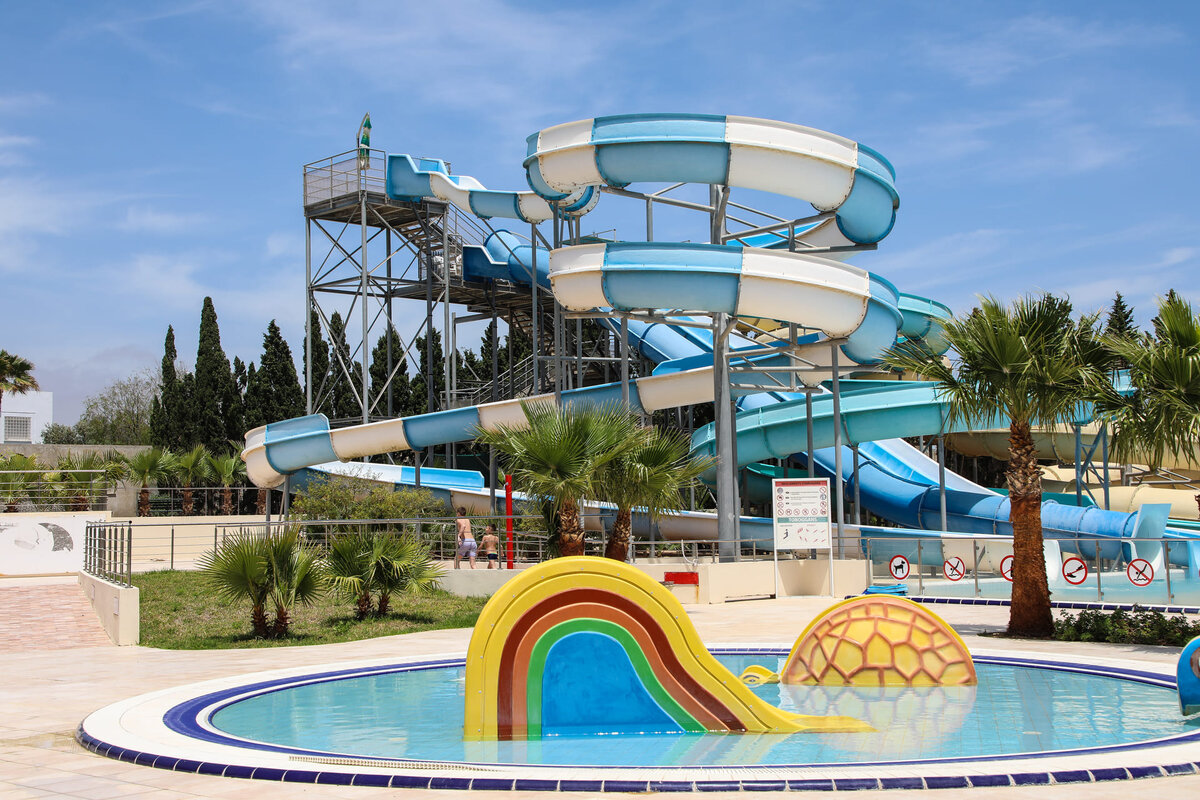
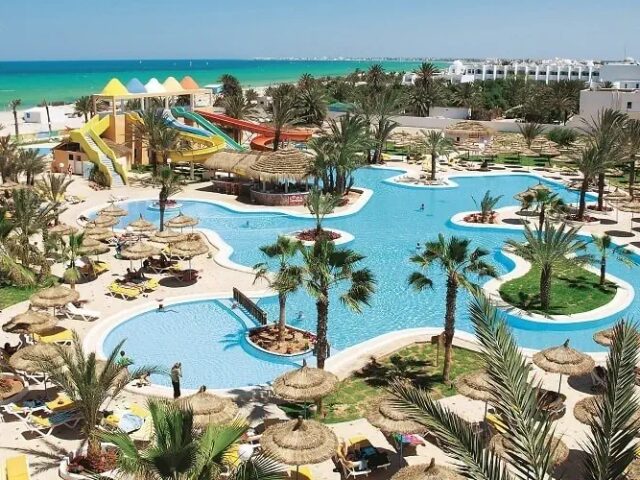
The beach bar, bars and restaurants served on open terraces, and the water slides normally operate from 1 June to 30 September. A hotel may keep them going if the weather holds, but it is under no obligation, and their absence after the season is not grounds for a complaint. Air conditioning follows the same logic: the compulsory cooling period runs from 15 June to 15 September, and after that each hotel decides for itself. With 27°C on Djerba in the first week of October, you will notice the difference.
Seasonal facilities swap places rather than simply disappear — the water park closes and the indoor pool opens. That makes the indoor pool — and whether it is heated — a far more useful question in October than the number of slides. The full list of services applies only in high season; outside it, the food and drink selection narrows as well, and that is precisely what pays for the lower price.
Seaweed is a separate matter. It washes ashore naturally in spring and autumn, most of all near harbours — Port El Kantaoui at Sousse and Yasmine Hammamet. The coastal protection agency APAL forbids hotels from removing seaweed from the beach: staff may rake it aside or cover it with sand to clear a path into the water, but they cannot cart it away. A hotel that leaves it there is following the rules, not breaking them, and a complaint on those grounds will go nowhere.
One thing does improve. Jellyfish reach the Tunisian coast between mid-July and mid-August, so in October they are simply not part of the picture.
Who is it for
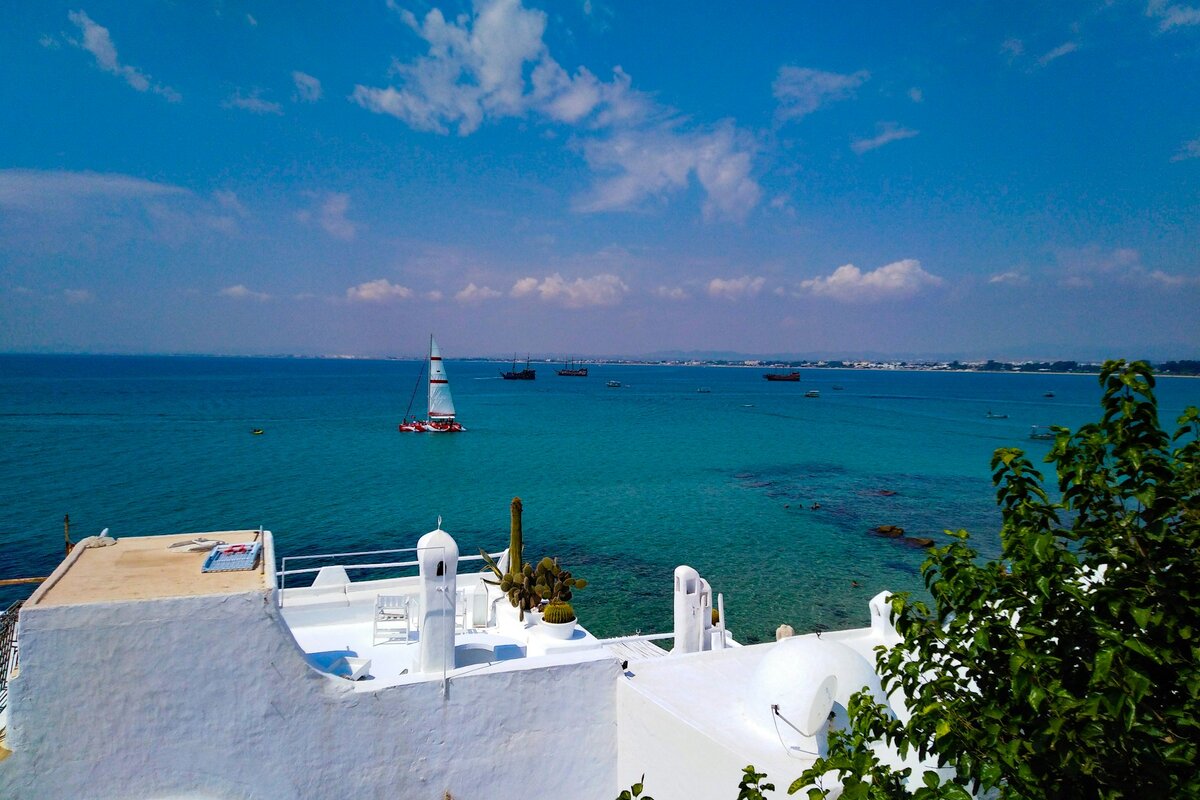
For couples and adults travelling without children, who are happy with a quiet hotel, an indoor pool, a thalasso centre and a free sunbed at any hour. Not worth it for a family that chose the hotel from a photograph of the aqua park: after 30 September the slides are goodwill rather than a guarantee, and the children's programme in the quiet season often shrinks to a single slot a day.
Which week should you book?
The dividing line falls around 25 October, when airlines move to their winter timetable and Poland puts the clocks back. Tunisia never changes its clocks and stays on UTC+1 all year, so until 25 October it runs an hour behind Warsaw and after that date the two are the same.
Prices early in the month still track September, then drop in the final week. In offers checked on 14 September, an all inclusive week from Katowice cost 2,749–3,139 PLN per person for 1–8 October, 3,289 PLN on Djerba for 15–22 October, and 2,839–2,849 PLN in Sousse and on Djerba for 22–29 October. Add 30 PLN in TFG and TFP contributions, plus the tourist tax paid at the hotel.
Flights work the other way round. The full charter programme from Warsaw, Katowice, Krakow, Wroclaw, Gdansk and Poznan runs until 25 October; after that only the winter schedule remains, with fewer departures and a shorter list of hotels. Winter dates do exist — a week in Hammamet from 22 to 29 November started at 2,089 PLN per person — but expect one flight a week rather than several.
Cheapest dates: the last week of October, up to 400 PLN per person below early-month prices
Timetable change: 25 October, the same night Poland moves to winter time
Sunset: 18:10 at the start of the month, 17:35 at the end
October is when the desert becomes bearable
The south returns to temperatures you can actually sightsee in. Daily highs in Douz fall from 31°C to 26°C over the month and in Tozeur from 32°C to 26°C, with an average high around 28°C and nights near 17°C. Rain is negligible: Tozeur records 11 mm across three days. July, by comparison, averages 39°C there and regularly goes past forty.
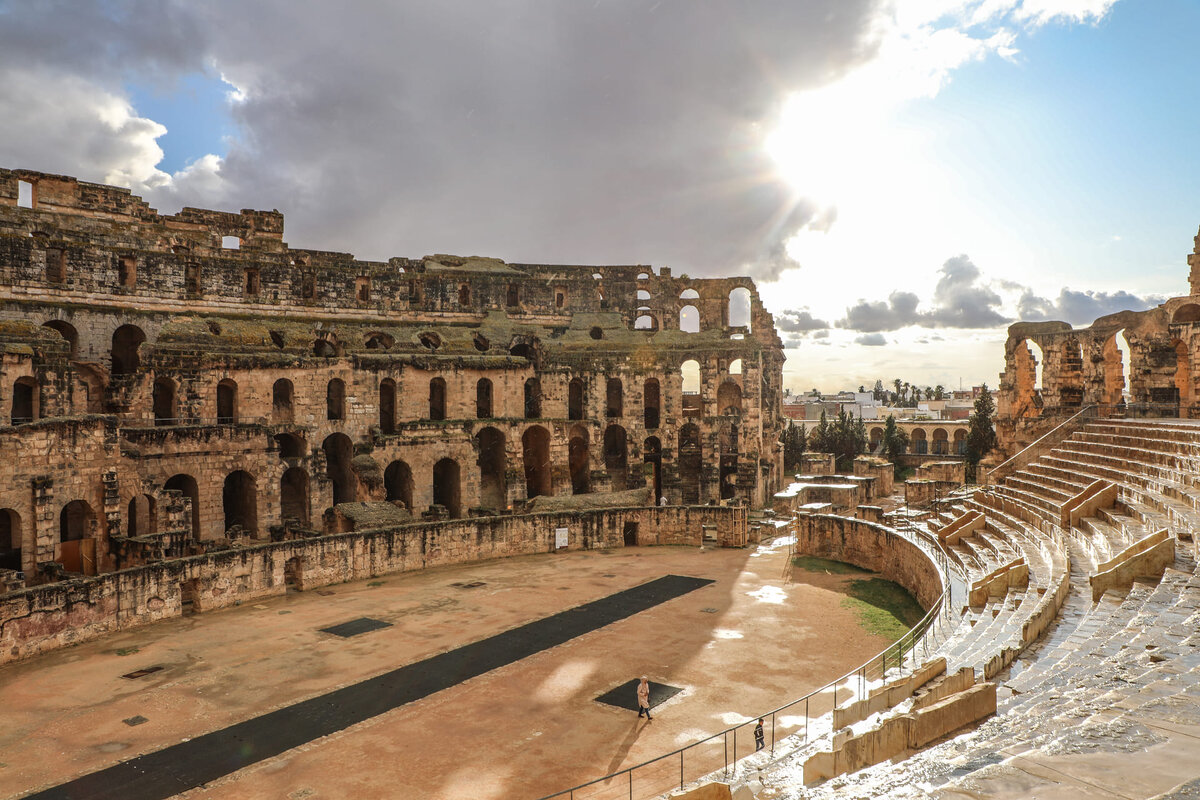
Two-day Sahara trips leave from Sousse, Hammamet, Monastir, Mahdia and Djerba. The usual route takes in the amphitheatre at El Jem, the Berber dwellings of Matmata and either Douz or the Ksar Ghilane oasis for the overnight stop, which adds up to some 1,200 km over two days. Departure from the hotel is around 6 a.m., and here is the detail people learn too late: Tunisian food safety rules forbid hotels from handing out packed meals, and an early breakfast — continental only — is served if you leave between 5 a.m. and 7 a.m. Leave before five and you get nothing.
Entry to the amphitheatre at El Jem costs 12 dinars, about 15 PLN, and covers the mosaic museum next to it. Archaeological sites switch to winter opening hours in autumn and close around 17:00–17:30 instead of 19:00, so with a shorter day it pays to confirm the final admission time with your rep.
One legal point is worth knowing before you book. The Polish foreign ministry advises against non-essential travel to the Sahara and the desert areas along the Algerian and Libyan borders, with tourist routes excluded from that advice. In practice an organised trip with a licensed operator falls within the exception, while a hire car and your own route into the sand is a different order of risk.
What to do
- Book the desert trip for the first half of your stay so a wet day still leaves room to move it
- Pack a fleece for the night in Ksar Ghilane or Douz: the desert drops to 15–17°C after dark
- Order the early breakfast at reception the day before and check your pick-up is not before 5 a.m.
- Reach El Jem independently if you prefer: the train from Sousse takes about an hour and costs 4–6 dinars
- Book thalasso treatments when you check in — payment is in full and in advance, and the timetable is shorter out of season
- On Djerba, look beyond the beach to Houmt Souk and the villages added to the UNESCO list in 2023: seven zones of the island and 24 separate sites
Who is it for
For travellers who treat the beach as a supplement: October is the one month that fits swimming, the desert and a Roman amphitheatre into a single week without heat exhaustion. Not worth it for anyone who struggles with pre-dawn starts and long drives — 1,200 km in two days, leaving at six in the morning, is an endurance exercise rather than a rest.
Tunisia or Egypt — which makes more sense in October?
In October the two destinations compete for the same traveller, and the choice comes down to a handful of numbers.
| Criterion | Tunisia | Hurghada |
|---|---|---|
| Flight from Warsaw | about 3 hours | about 4 hours 40 minutes |
| Sea | +21–25°C depending on the resort | +27°C |
| Daytime air | +24–28°C | +26–30°C |
| Rainfall | 10–94 mm depending on the region | next to none |
| All inclusive week for two | 5,500–6,600 PLN | 4,700–8,700 PLN |
| Beyond the beach | Sahara, El Jem, Carthage, thalassotherapy | reef diving, Luxor four hours away |
Egypt wins on water temperature and on certainty, since rain barely registers in Hurghada in October. Tunisia is ahead on other counts: 90 minutes less flying, ruins within an afternoon of the hotel, and a final week that undercuts Egyptian prices. There is a third difference worth naming — Tunisian hotels have 30 September written into their season, whereas the Red Sea resorts run at full capacity right through the winter.
Who is it for
Tunisia suits travellers from Poland with more than sunbathing in mind, anyone who copes badly with long flights, and parents of small children counting every hour in the air. Not worth it for a traveller whose entire list is a warm sea and a pool: the Red Sea gives four degrees more for the same money, in hotels with no seasonal exceptions attached.
Passports, residence cards and a currency you cannot take home
Entry depends on the citizenship in your passport. A Polish residence card, a permanent residence permit or a Schengen visa give no right of entry — Tunisia sits outside Schengen, and a Polish residence document counts for nothing at the border. The passport itself must be valid for at least three months beyond your planned departure from Tunisia, or six months if you have no return ticket.
Holders of a Belarusian passport enter without a visa and may stay up to 90 days. A Ukrainian passport gives visa-free entry only as part of an organised tour with flights included. A hotel and flights booked separately do not qualify, and the visa then has to be arranged in advance. Ask your tour operator for the contract or voucher confirming that an organised tour was bought, and carry it at the airport. The airline decides whether you board and the Tunisian border service decides whether you enter, and residents of Poland flying out of Warsaw rather than from their country of citizenship are asked for those documents more often at check-in. Polish citizens need no visa for stays of up to three months, but since 1 January 2025 an identity card is no longer accepted — everyone, children included, needs a passport.
At the hotel, every guest aged 12 and over pays a tourist tax on arrival: 4 dinars per night in a two-star hotel, 8 in a three-star and 12 in a four- or five-star, capped at ten nights. At 1.29 PLN to the dinar, a week for two in a four-star comes to 168 dinars, roughly 217 PLN, and it is not included in the price of the holiday. It is payable on the spot and in dinars only.
The dinar may not be brought into the country or taken out of it. Change money locally and keep the exchange receipt, because without it you cannot convert what is left before your flight; airport banks operate around the clock. Cash and cards both work, but shops will not accept euros or dollars.
Safety, finally. The Polish foreign ministry advises against non-essential travel to the Sahara and the desert zones along the Algerian and Libyan borders outside tourist routes, and to the Orbata, Selloum, Semema, Chambi and Mghila mountains; elsewhere it recommends particular caution. A state of emergency has been in force since 2015, and one practical consequence is a ban on photographing military and government sites and personnel — breaking it carries detention of at least five days. Insurance is essential: a doctor's visit costs 50–100 dinars.
Document: a passport valid for three months beyond your departure from Tunisia
Tourist tax: 4 / 8 / 12 dinars per person per night, from age 12, maximum ten nights
Exchange rate: 1 dinar is about 1.29 PLN, and the currency can only be changed inside Tunisia
Ukrainian passport: visa-free only with an organised tour; carry the contract and tickets
Check before you book:
- Whether the hotel has an indoor pool and whether it is heated — slides may not run after 30 September
- Whether air conditioning is switched on during your dates; it is compulsory only until 15 September
- How close the hotel beach is to a harbour, where autumn seaweed collects
- What the tourist tax comes to for your hotel category, and whether you will have dinars for it
- That every passport, including the children's, is valid three months beyond your return
- Whether your return flight falls before 25 October or after the switch to the winter timetable
Common mistakes:
- Choosing a hotel from aqua park photographs. They were taken in July, the standard slide season ends on 30 September, and no hotel is obliged to extend it.
- Picking the north for a beach holiday. Tabarka and Bizerte get around 94 mm of rain and 21°C water in October, which is a different trip from Djerba.
- Complaining about seaweed. Hotels are banned from clearing it, and the autumn wash-up is normal along this coast.
- Relying on a residence card instead of a visa. A Polish residence document has no bearing on entry to Tunisia; citizenship and passport decide.
- Changing money without keeping the receipt. Without it your leftover dinars cannot be converted back, and taking them home is prohibited.
The verdict for each type of traveller
Yes, if you fly south and choose the hotel for October rather than for July.
For couples and anyone travelling without children this is one of the better months of the year: water warmer than in June, empty beaches, prices below September, and thalassotherapy running all year in a country second only to France for it, with sixty centres. Families with small children should stick to the first half of the month and to a hotel with a heated indoor pool. For anyone drawn to ruins and the desert there is no better month — 28°C in Tozeur instead of forty. And travellers whose only requirement is warm water will do better on the Red Sea.
One practical piece of advice:
Before you pay, ask the agency to confirm two things in writing: whether the indoor pool is open on your dates, and whether the hotel runs the air conditioning outside the compulsory period. It takes two sentences in an email, and the difference between a hotel that answers precisely and one that replies in generalities tells you more about the quiet season than any review written in August.

 Holidays


 Last minute
 Hotels


 Blog