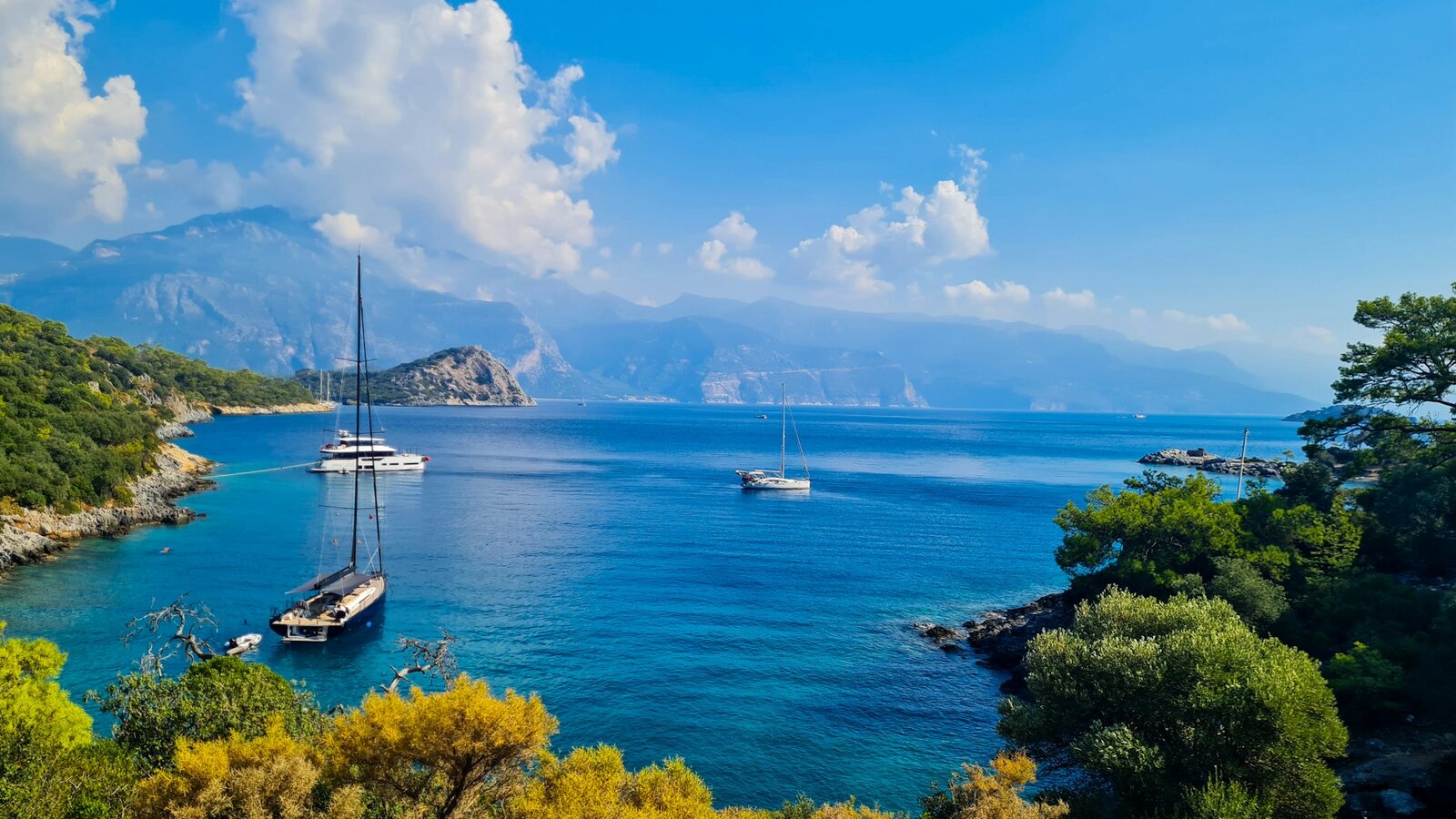
The difference between Alanya in August and Bodrum in August isn't the hotel's star rating or what's included in "all-inclusive" — it's five degrees of air temperature and a wind that never lets up. On the Mediterranean coast the sea warms to +28°C, but July air sits under +38°C and simply doesn't move; the Aegean runs two or three degrees cooler and the meltemi blows most days, which changes how that same heat feels entirely. That's the real fork in a Turkish holiday: you choose the sea first, and only then the resort and the hotel.
Below we break down the Turkish coast by sea — the Mediterranean, split into the Antalya and Lycian stretches, then the Aegean and the Black Sea — and work through every resort worth knowing within each: what's underfoot at the beach (sand, pebble or platform), how warm the water runs month by month, how long the flight from Poland takes, what the transfer looks like, and what a week for two costs. At the end: a comparison table, a checklist, common mistakes, and the 2026 entry rules.
- The warmest sea and the longest season → The Mediterranean coast
- Ultra all-inclusive and water parks → Side, Alanya
- Premium, golf and the best family beaches → Belek
- Mountains right down to the sea → Kemer
- A proper town, airport close by, day trips → Antalya
- Turquoise coves and lagoons → Fethiye and Ölüdeniz, Kaş and Kalkan
- Wind, cooler air, more style → The Aegean coast
- Clubs, a marina and fashionable bays → Bodrum
- Antiquity right next to the beach → Kuşadası
- Budget and kilometres of sand → Didim
- A holiday without package tours → The Black Sea
- Compare everything at once → Comparison
The Mediterranean coast: the warmest for the longest
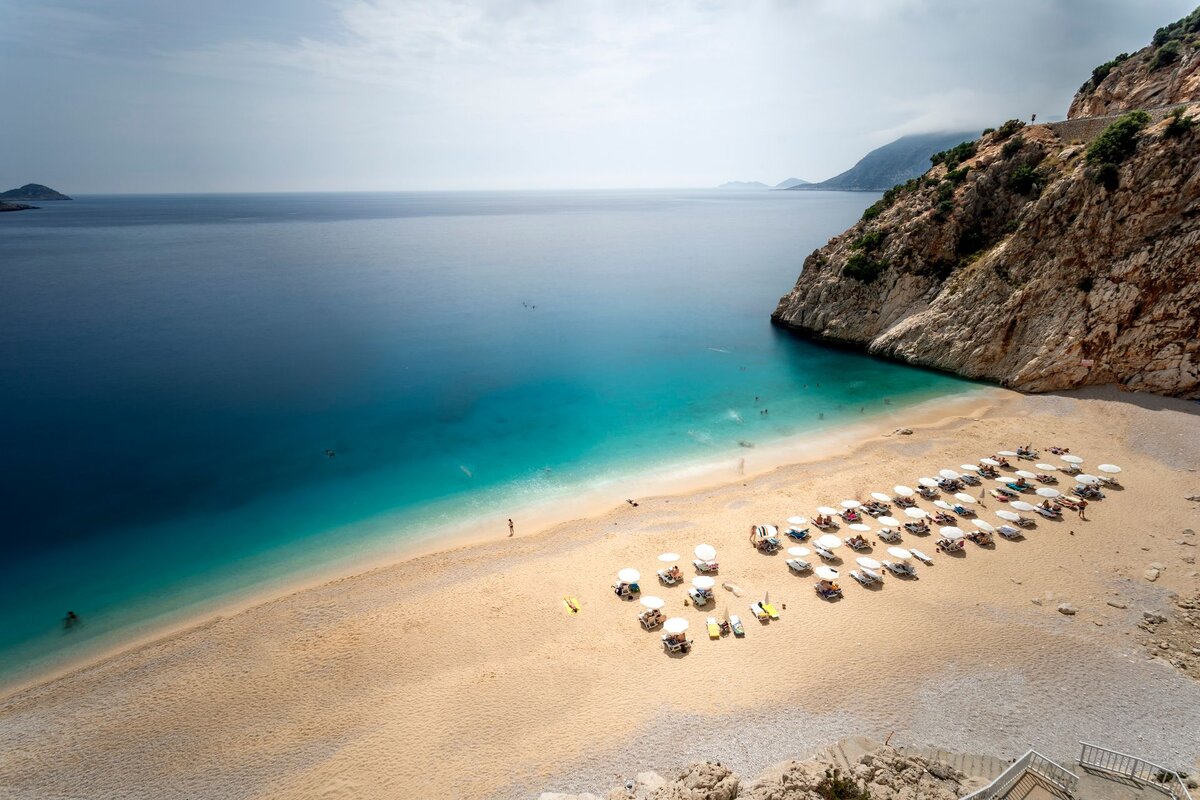
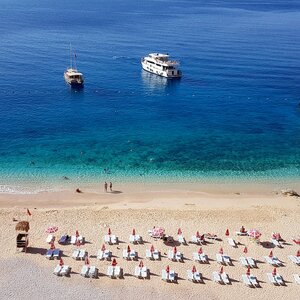
The southern coast from Kemer to Alanya is what "a holiday in Turkey" usually means: the country's warmest water, the longest season and the densest concentration of big hotels running ultra all-inclusive. The sea here warms to +27–28°C and stays swimmable into late October, in some years even early November. The price for that is heat: in July and August the air in Side and Alanya pushes past +35°C, with almost no wind to take the edge off. The main airport is Antalya, with transfers from 30 minutes to 2 hours depending on the resort.
| Month | Air (day) | Sea | Note |
|---|---|---|---|
| May | +26–29°C | +21–23°C | Not everyone swims yet, but ideal for sightseeing |
| June | +30–33°C | +24–26°C | The sweet spot: warm without the furnace |
| July–August | +33–38°C | +27–28°C | Peak heat and prices; shade by day is essential |
| September | +30–33°C | +27°C | The best month of the season |
| October | +26–29°C | +24–25°C | The sea's still warm, the crowds have thinned |
Antalya: Lara, Konyaaltı and Kaleiçi
"The only resort where the sea comes with an actual city attached"
A city of a million and a half with the airport inside the city limits — you fly here to avoid burning your holiday on transfers: it's 20–30 minutes to the Lara hotels, about 40 to Konyaaltı. The districts differ sharply. Lara is a long sandy beach and large five-star hotels, including the famous "themed" ones with palace replicas. Konyaaltı is a pebble beach under the Bey Mountains with a city promenade. Between them sits the old quarter of Kaleiçi, with Hadrian's Gate, Ottoman-era wooden mansions and a yacht harbour. Antalya is also the best base for day trips: Pamukkale, the Köprülü canyon, ancient Perge and Aspendos. Not worth it if you want resort quiet by the sea — this is a busy city with traffic, and the city beaches are packed in August.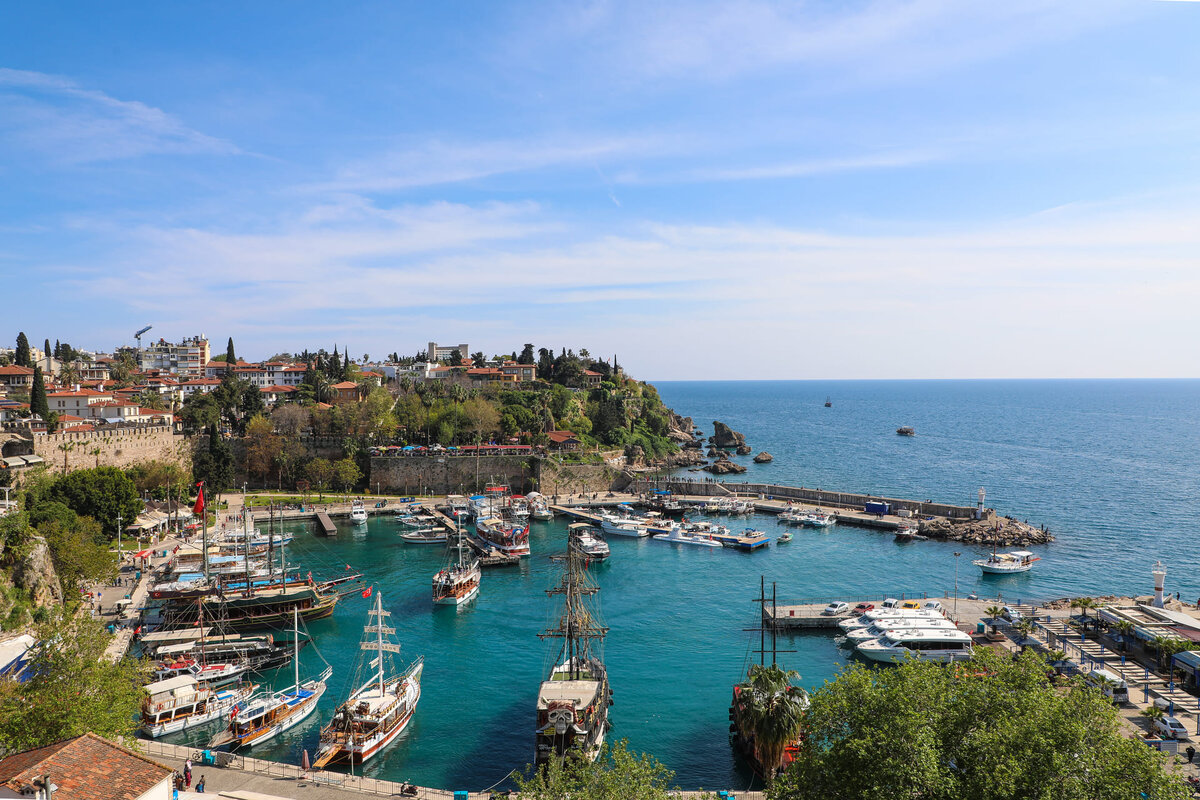
In front of the hotel: sand at Lara, coarse pebble at Konyaaltı
Flight from Warsaw: ~3 hrs 20 min, transfer 20–40 min
7 nights / 2 people: PLN 4,500–12,000
Best season: May–June and September–October
What to do
- Walk Kaleiçi from Hadrian's Gate down to the old harbour in the evening, and eat in the back lanes rather than on the waterfront
- Visit ancient Aspendos — a 2nd-century Roman theatre with its stage intact, still used for concerts today
- Take the Tünektepe cable car above Konyaaltı — the whole bay and the mountains in one frame
- Get to the Kurşunlu waterfalls in the morning — a pine canyon 20 minutes from the airport, before the coach tours arrive
Belek
"The coast's premium tier: pine forest, golf and the best sand for children"
A resort built entirely around five-star hotels: a wide strip of golden sand with a very gentle entry, pine forest down to the water, and around fifteen world-class golf courses. This is where the density of big water parks, kids' clubs and included à la carte restaurants is highest on the coast — if you're buying "the formula", Belek delivers it in its fullest form. The local quirk isn't the beach style but loggerhead turtles, which nest here, so some beaches close and go unlit at night. Not worth it if your budget is tight or you want to step outside the gate: there's barely a village here, life happens entirely inside the hotels, and prices are the coast's highest.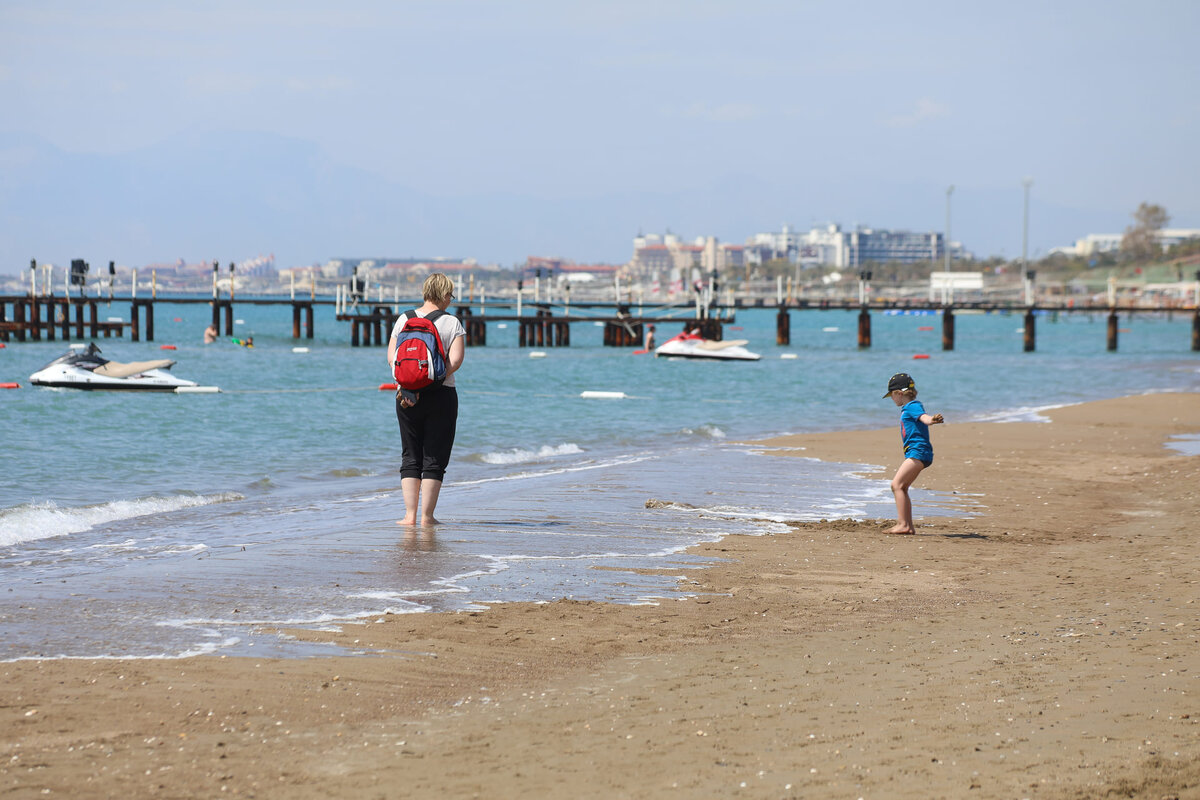
In front of the hotel: wide golden sand, a very gentle entry — ideal with young children
Flight from Warsaw: ~3 hrs 20 min + ~40 min transfer
7 nights / 2 people: PLN 6,000–20,000
Best season: June and September; in August everything's booked and pricey
Side, Kumköy and Çolaklı
"An ancient temple right on the beach — and the best value formula on the coast"
Side is the rare case where the ruins aren't "near the resort" but inside it: the village's main street runs through an ancient gate, and the Temple of Apollo stands on the headland at the water's edge, its columns silhouetted against the sunset from the sand. Around it stretch the resort zones with the big hotels: Kumköy and Çolaklı to the west, Sorgun and Kızılağaç to the east. The beaches are sandy, in places sand-and-pebble, the water warm and calm. Financially this is the coast's most rational point: the all-inclusive formula here comes close to Belek's level, at noticeably lower prices. Not worth it if dense tourist development and souvenir stalls put you off: central Side in summer is essentially one long shopping street, and you need to head to Sorgun or Kızılağaç for quiet.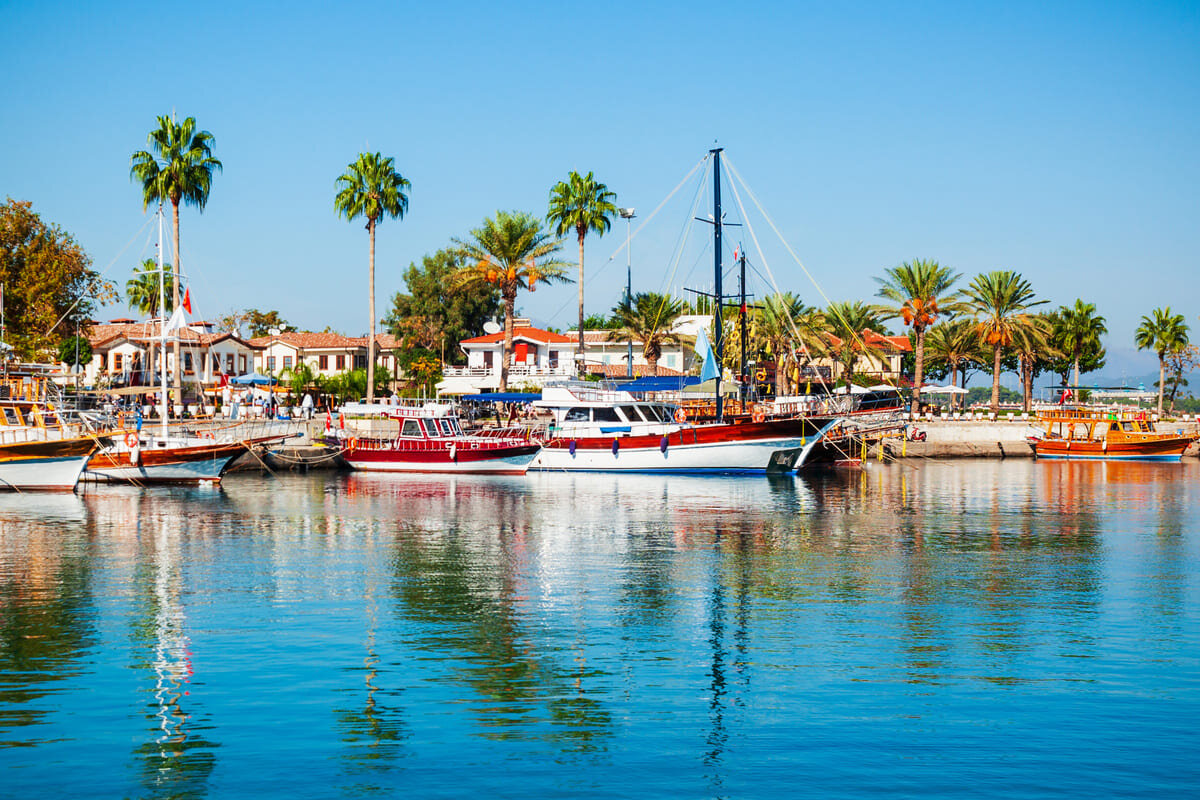
In front of the hotel: sand, in places sand mixed with pebble; the entry is generally gentle
Flight from Warsaw: ~3 hrs 20 min + ~1 hr 15 min transfer
7 nights / 2 people: PLN 3,500–9,000
Best season: June and September–October
What to do
- Watch the sunset at the Temple of Apollo — the columns against the sea outdo any viewpoint
- Take a trip to the Manavgat river and waterfall, then a boat down the delta to the sea
- Walk through Side's 15,000-seat amphitheatre — one of the largest in Asia Minor, right on the main street
- Go white-water rafting in the Köprülü canyon (around 1.5 hours away) — the river runs at +10–12°C even in August, and that's the whole point
Alanya, Konaklı, Avsallar and Mahmutlar
"The most affordable stretch of coast — and the biggest gap between districts"
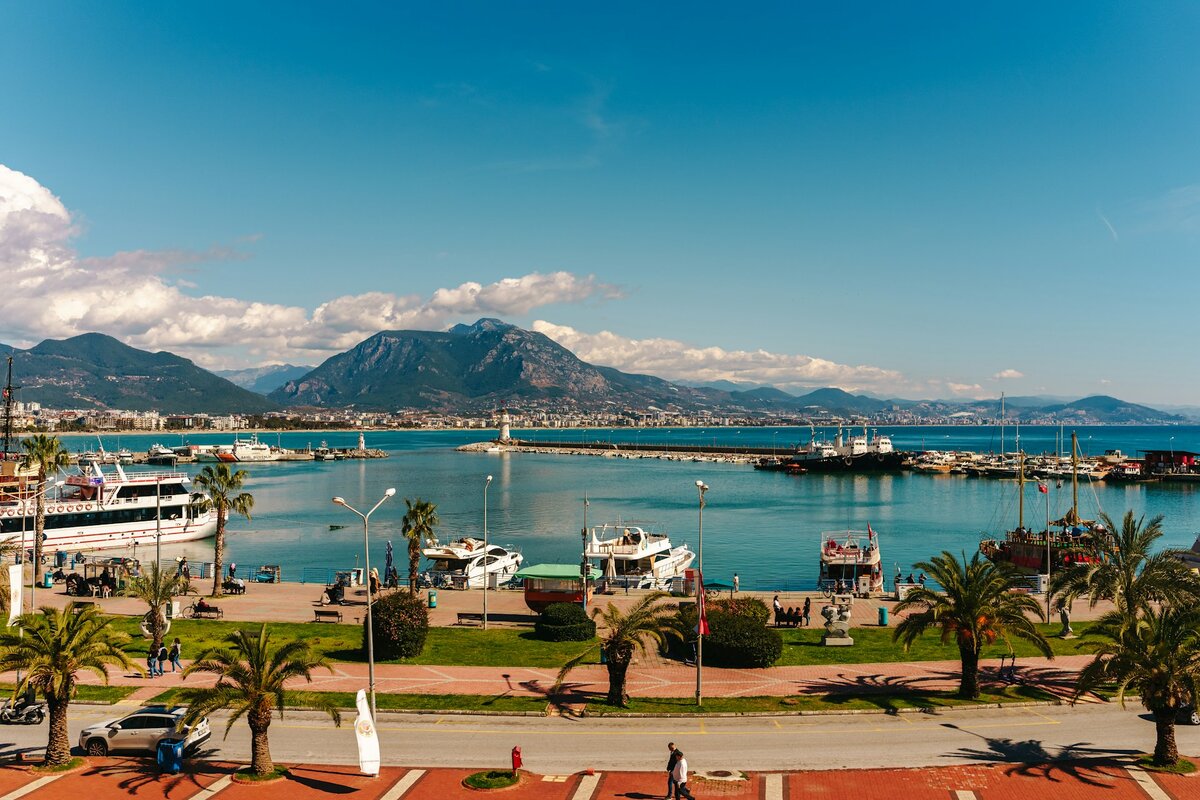
The eastern edge of the Antalya coast and Turkey's main budget benchmark: week-long packages here have traditionally been the cheapest on the Mediterranean. The centre is a clifftop fortress above two beaches, Cleopatra and Keykubat, a lively evening promenade and dense town development. Further along the coast the character shifts by district: Konaklı and Avsallar with İncekum are calmer and greener, with good sand; Mahmutlar is effectively a residential district of flats at low prices; Okurcalar and Türkler are outlying hotel zones. Alanya is also the coast's hottest spot — +36–38°C in July–August is normal here. Not worth it if the transfer time matters: it's 2 to 2.5 hours from Antalya airport, which is a lot to face after a night flight; Gazipaşa airport is closer, but few flights from Poland go there.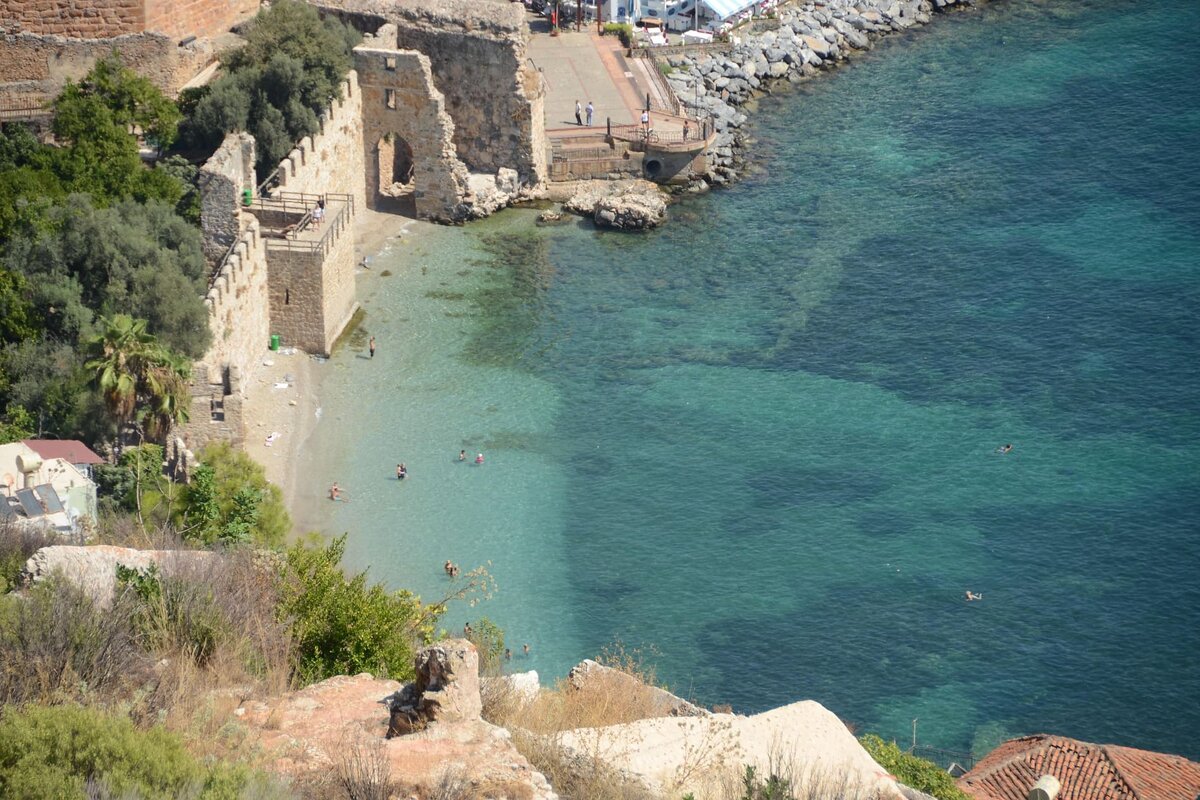
In front of the hotel: sand and sand-with-pebble; the central beaches are narrow and crowded
Flight from Warsaw: ~3 hrs 20 min to Antalya + 2–2.5 hrs transfer
7 nights / 2 people: PLN 3,000–7,000 — the coast's most affordable option
Best season: May–June and September–October; July–August is very hot
What to do
- Take the cable car up to Alanya Castle and walk back down through the gardens to the Red Tower
- Swim into Damlataş cave and the sea grottoes beneath the castle on a boat trip
- Head to the mountain village of Güzelbağ for trout, and the Sapadere canyon — 8–10 degrees cooler than the coast
- Buy fruit and spices at Mahmutlar's big Tuesday market rather than the seafront stalls
Kemer: Beldibi, Göynük, Kiriş, Çamyuva and Tekirova
"Pine forest and mountains down to the water — and pebble instead of sand"
West of Antalya the Taurus mountains run straight down to the sea, and Kemer looks nothing like the rest of the coast: pine forest to the shoreline, clear water and mountain ridges behind the hotel. That clarity is exactly why snorkellers and divers come here. The resort strip runs for 50 kilometres: Beldibi closest to Antalya, then Göynük, Kemer itself with its marina, then Kiriş, Çamyuva and Tekirova at the foot of the mountains. The one thing worth knowing in advance: the beaches are pebble, the entry often steep, and water shoes make life easier. Not worth it for young children who need a gentle sandy entry — and worth remembering that the mountains bring shade earlier: the sun leaves the beach sooner in the afternoon here than in Side.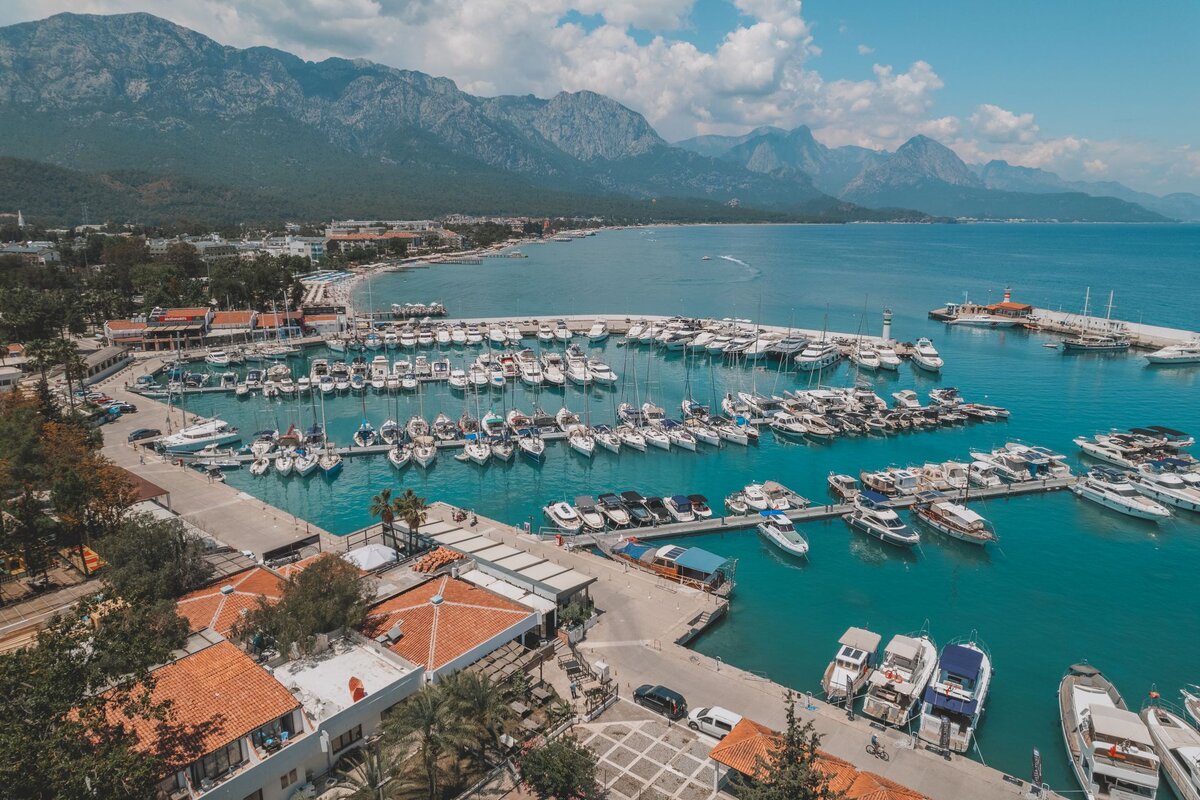
In front of the hotel: pebble, sometimes coarse; the clearest water on the coast
Flight from Warsaw: ~3 hrs 20 min + 40–70 min transfer
7 nights / 2 people: PLN 3,500–8,500
Best season: June and September; the mountains bring cooler evenings
What to do
- Visit the Chimaera flames at Mount Yanartaş in the evening — natural fires that have burned out of the rock for thousands of years
- Walk a stretch of the Lycian Way from Çıralı to ancient Olympos — ruins sitting right among the undergrowth by the sea
- Take the Tahtalı cable car (2,365 m) — from beach to alpine view in 10 minutes
- Book a yacht trip to the bays of Phaselis — an ancient city with three harbours, better approached by water than by road
The Lycian coast: coves instead of hotel strips
The south-western stretch between Antalya and Marmaris is the most scenic part of the Turkish coast: fjord-like bays, pine, cliffs and water that gets called turquoise without exaggeration. Hotels here run smaller on average, all-inclusive is less common, and instead of entertainment programmes you get yachts, paragliding and hiking. The airport is Dalaman, occasionally Antalya.
Fethiye, Ölüdeniz, Hisarönü and Çalış
"The Blue Lagoon and paragliding — the south-west's defining postcard"
Ölüdeniz, with its lagoon and pebble spit, is Turkey's most photographed beach, and at the same time one of the world's paragliding hubs: dozens of tandem flights launch daily from Mount Babadağ (1,969 m), with the flight over the lagoon lasting 20–30 minutes. Nearby, Fethiye is a lively port town with a market and marina; the resort strip of Çalış has a long beach and good sunsets; boisterous Hisarönü has the bars. The lagoon water is calm and shallow; the open sea entry is pebble. Not worth it if you want a classic hotel-formula holiday: there aren't many big ultra complexes here, the lagoon itself is a paid entry and packed in August, and the transfer from Dalaman is about an hour, from Antalya almost four.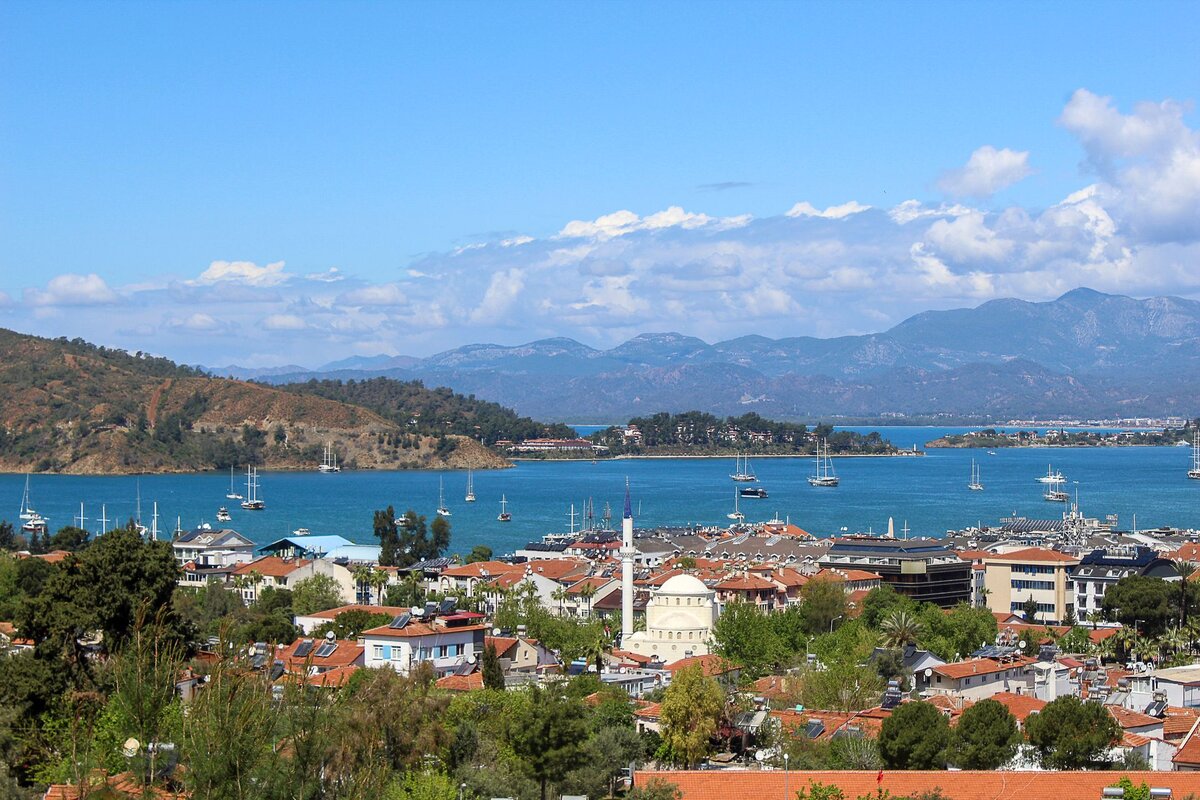
In front of the hotel: pebble and pebble-with-sand; Ölüdeniz lagoon is a separate paid entrance
Flight from Warsaw: ~3 hrs 10 min to Dalaman + ~1 hr transfer
7 nights / 2 people: PLN 4,000–9,000
Best season: June and September; flights depend on the wind
What to do
- Take a tandem flight off Babadağ in the morning — the wind picks up after midday and afternoon flights are often cancelled
- Visit the Butterfly Valley — reachable by boat from Ölüdeniz or a steep path from above
- Visit the ghost village of Kayaköy — a Greek village of 500 stone houses abandoned in 1923
- Take the "12 Islands" day yacht tour from Fethiye — the water in the bays is clearer than close to shore
Kaş, Kalkan and Patara
"Boutique Turkey: diving, stone lanes and no water parks in sight"
Two small clifftop towns you visit for the atmosphere rather than the formula. Kaş is Turkey's diving centre: underwater walls, a sunken plane and ancient ruins on the seabed, with 20–30 metres of visibility. Kalkan is whitewashed houses draped in bougainvillea, stepped lanes down to the sea and rooftop restaurants; instead of beaches you'll mostly find concrete platforms and beach clubs. Between them lies Patara — eighteen kilometres of wild sandy beach beside an ancient city, a protected turtle-nesting site, which is why the beach closes at sunset. Not worth it for families counting on all-inclusive and entertainment programmes: hotels here are small, with plenty of villas and boutique guesthouses, and it's 2–2.5 hours from Dalaman.
In front of the hotel: platforms and pebble coves; genuine sand only at Patara
Flight from Warsaw: ~3 hrs 10 min to Dalaman + 2–2.5 hrs transfer
7 nights / 2 people: PLN 4,500–10,000
Best season: May–June and September–October
Sarigerme, Dalaman and Göcek
"Closest to the airport — and calmer than its neighbours"
Sarigerme is a family resort 15–20 minutes from Dalaman airport: a long beach of dark, fine sand with a gentle entry, pine trees and a handful of large hotels without the bustle of a town around them. Nearby Göcek is the region's yachting capital, the starting point for Blue Cruise voyages through the bays, expensive and quiet. Not worth it if you want a choice of restaurants, shops and evening entertainment outside the hotel: the villages are small, and without excursions a week here can start to feel repetitive.
In front of the hotel: dark, fine sand, gentle entry — easy with children
Flight from Warsaw: ~3 hrs 10 min to Dalaman + 15–30 min transfer
7 nights / 2 people: PLN 4,000–9,500
Best season: June–September
The Aegean coast: cooler, windier, more stylish
The western coast works on entirely different principles: the water runs two or three degrees cooler than the Mediterranean, but the meltemi — a northerly wind — blows almost constantly, making the heat bearable and turning the region into a hub for sailing, kiting and windsurfing. The season is shorter, comfortable from mid-June to September. Hotels average smaller, all-inclusive is less common, and antiquity is everywhere: Ephesus, Didyma, Priene, Miletus. The airports are Bodrum and Izmir.
| Month | Air (day) | Sea | Wind |
|---|---|---|---|
| May | +24–27°C | +19–20°C | Moderate, early for swimming |
| June | +28–31°C | +22–23°C | The meltemi begins |
| July–August | +31–34°C | +24–26°C | The meltemi blows nearly every day |
| September | +28–30°C | +24–25°C | Weakening; the best month |
| October | +23–26°C | +22–23°C | The season winds down |
Marmaris, İçmeler and Datça
"A pine-fringed bay with the loudest promenade in the south-west"
Marmaris sits in an enclosed bay ringed by pine-covered mountains: the water is calm, the promenade long, and its "Bar Street" is one of the loudest in the country. The town beach is fine pebble and crowded; five kilometres away in İçmeler the water is noticeably cleaner and the mood calmer — most people who know both choose İçmeler. Ferries to Rhodes (about an hour) leave from here, along with Blue Cruise departures. Further west runs the Datça peninsula — a 100-kilometre drive to quiet bays and almond groves that package tourists rarely reach. Not worth it for families with children in central Marmaris: the nightlife runs till morning, and you'll need to travel for cleaner water.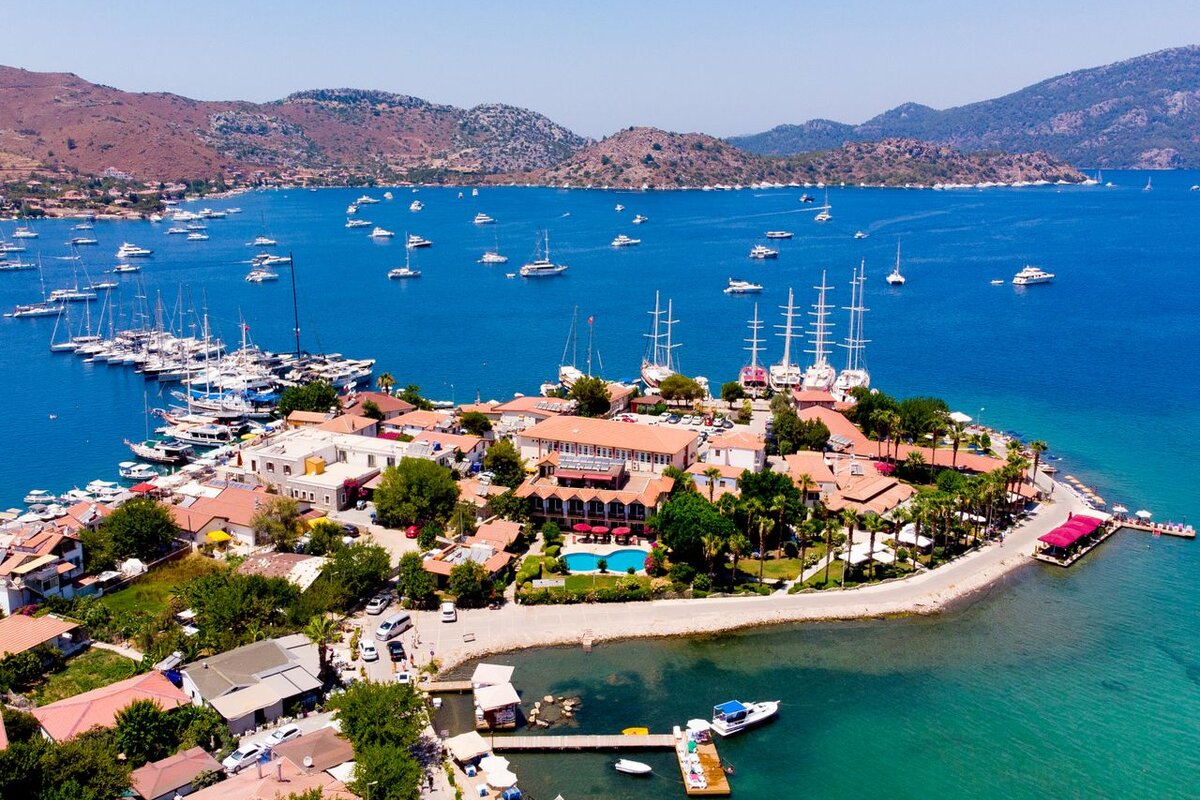
In front of the hotel: fine pebble and pebble-with-sand; İçmeler's water is cleaner
Flight from Warsaw: ~3 hrs 10 min to Dalaman + ~1.5 hrs transfer
7 nights / 2 people: PLN 3,500–8,500
Best season: June and September
Bodrum: Gümbet, Turgutreis, Yalıkavak and Bitez
"The country's most fashionable peninsula — with different resorts half an hour apart"
Bodrum isn't one resort but a peninsula of twenty-odd bays, and the difference between them is bigger than between separate towns. Bodrum town itself has whitewashed houses, the 15th-century Castle of St Peter, a marina and nightlife. Gümbet next door is loud and young. Bitez is quieter, with olive groves and windsurfing. Turgutreis has sunsets and a long promenade. Yalıkavak is the premium marina, full of yachts and expensive restaurants. A common thread runs through all of them: the beaches tend to be small, pebble or artificially topped up with sand, and beach clubs with platforms are everywhere. A height restriction on new building means there's no wall of tower-block hotels here either. Not worth it if you're counting on a broad sandy beach and ultra all-inclusive on a tight budget — Bodrum runs above the Turkish average and lives more by its bays and clubs than its formula.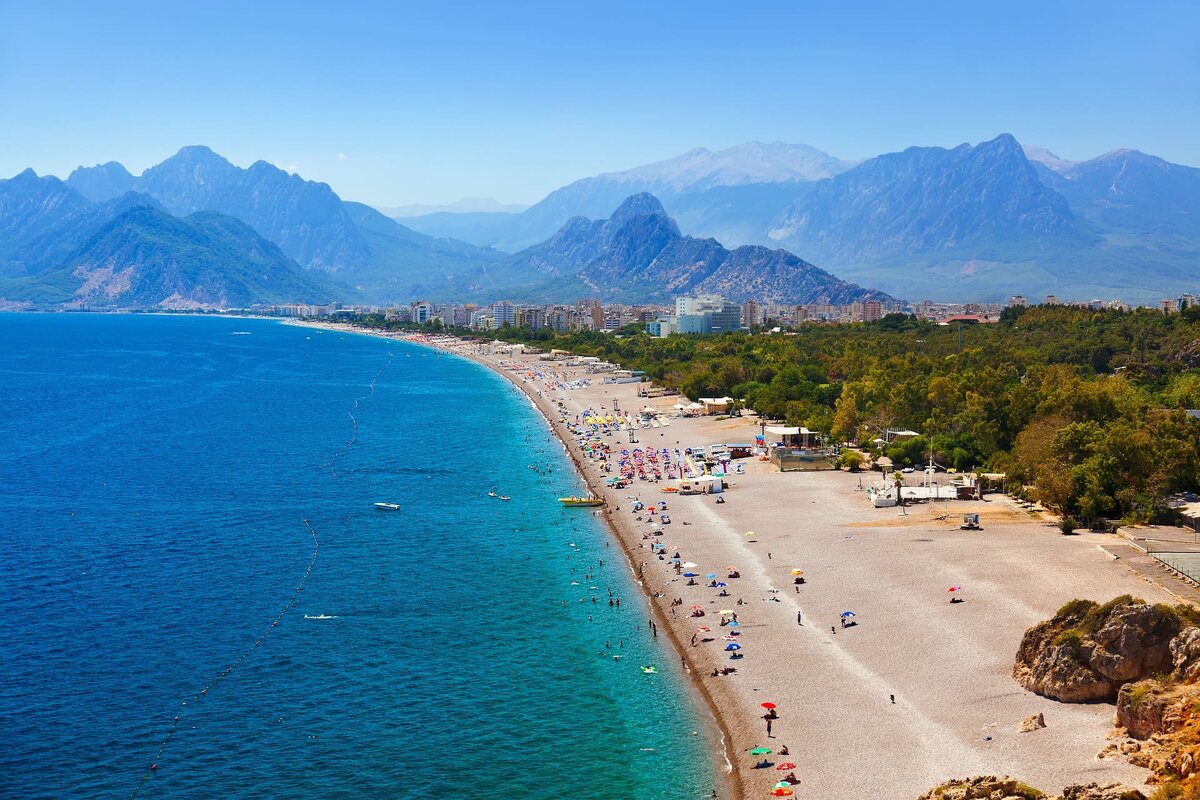
In front of the hotel: small pebble beaches, platforms and beach clubs
Flight from Warsaw: ~2 hrs 50 min to Bodrum + 20–50 min transfer
7 nights / 2 people: PLN 4,500–14,000
Best season: July–September; the sea's still cool in June
What to do
- Visit the Castle of St Peter and its underwater archaeology museum — one of the world's best collections of Bronze Age shipwrecks
- Catch sunset in Turgutreis, looking across at the Greek islands opposite
- Take a boat to Orak Island, for the clearest water in the area
- Go to Yalıkavak's Saturday market for local olives, cheese and spices instead of the resort shops
Kuşadası
"The base for Ephesus — with sandy beaches and none of the Mediterranean heat"
A port resort facing the Greek island of Samos, where cruise ships call in and ancient Ephesus is just 20 minutes away. This may well be the country's best combination of beach and archaeology: three major ancient cities sit nearby (Ephesus, Priene, Miletus), along with the House of the Virgin Mary and Didyma with its Temple of Apollo. The beaches are sandy and well kept — Ladies Beach in town and the 10-kilometre-plus Long Beach further south. The heat is easier to take than in Antalya, thanks to the Aegean wind. Not worth it if you want quiet: on cruise-ship days the centre and the bazaar are packed, and the sea is cooler than the Mediterranean even at the height of summer.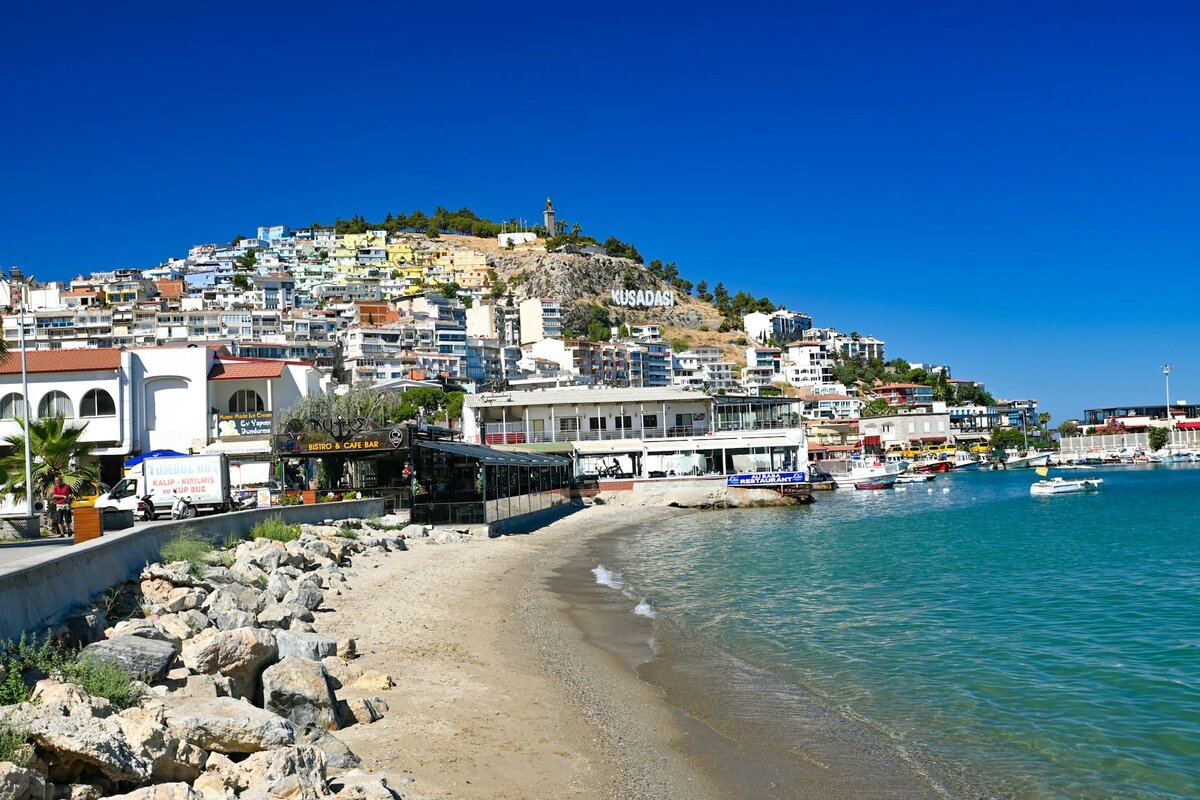
In front of the hotel: sandy beaches, gentle entry; Long Beach is roomier than the town beach
Flight from Warsaw: ~2 hrs 50 min to Izmir + ~1.5 hrs transfer (or Bodrum + ~2.5 hrs)
7 nights / 2 people: PLN 3,500–8,000
Best season: July–September; May or October are better for Ephesus itself
What to do
- Arrive at Ephesus at opening time — walk the marble street to the Library of Celsus before the heat and the cruise coaches arrive
- Pay the separate entry for the Ephesus Terrace Houses — mosaics and frescoes of Roman-era apartments, under cover
- Visit Şirince — a hillside village of fruit wines 30 minutes from Ephesus
- Walk the causeway to Pigeon Island with its Genoese fortress, right in the resort centre
Didim and Altınkum
"Kilometres of sand at the lowest prices on the Aegean"
A resort built around Altınkum beach — the name translates as "golden sand", and it's honestly named: fine sand, a very gentle entry, calm water in a sheltered bay. Prices here run below Kuşadası and Bodrum, and nearby stands the Temple of Apollo at Didyma — one of the largest ancient temples in the Mediterranean, its columns over ten metres tall. Not worth it if hotel standard matters to you: the base here is mostly three- and four-star, aimed at the mass and British market, and resort life mostly means the seafront cafés.
In front of the hotel: fine golden sand, a very gentle entry
Flight from Warsaw: ~2 hrs 50 min to Bodrum + ~1.5 hrs transfer
7 nights / 2 people: PLN 3,000–7,000
Best season: July–September
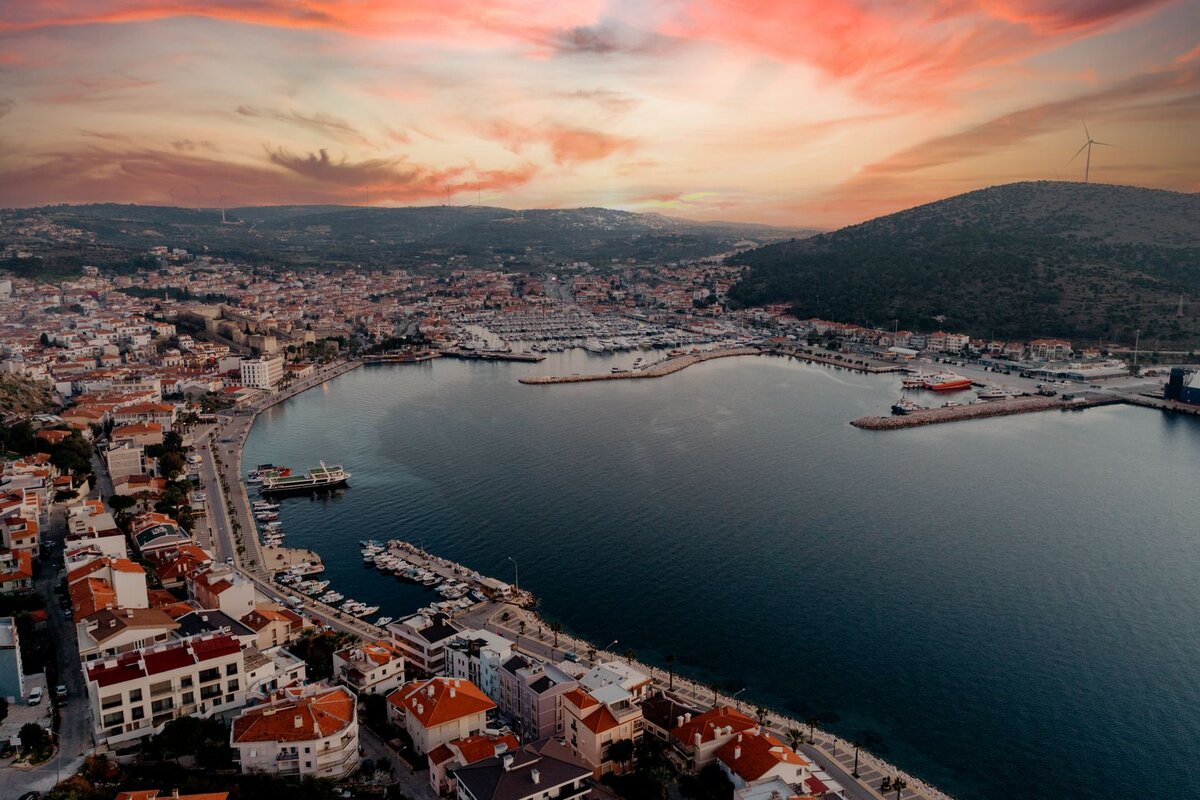 and Alaçatı
"Kitesurfing, thermal springs and the resort Turks pick for themselves"
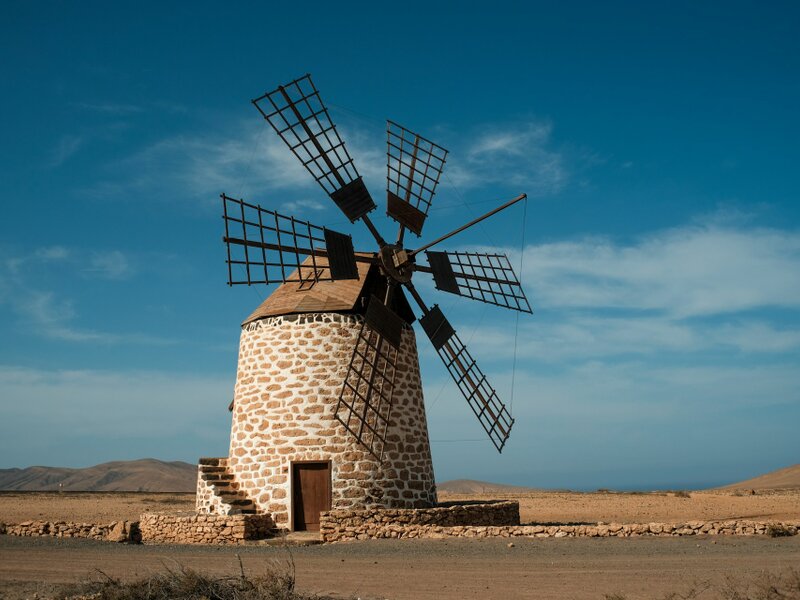
A peninsula west of Izmir, and the most "domestic" of Turkey's resorts: this is where Istanbul and Izmir residents come first, so both service and prices are pitched at the local market. Alaçatı is stone houses with blue shutters, windmills and one of Europe's best kitesurfing spots: the bay is shallow with a flat bottom and a reliably steady wind. Çeşme itself has the white sand of Ilıca and thermal springs that flow straight into the sea. Not worth it if you want classic all-inclusive and a direct flight from Poland tailored to a specific hotel: package programmes here are thin on the ground, and this stretch has the coolest water on the coast — rarely above +24°C in July.
In front of the hotel: white sand at Ilıca, bays and platforms elsewhere
Flight from Warsaw: ~2 hrs 50 min to Izmir + ~1.5 hrs transfer
7 nights / 2 people: PLN 5,000–13,000
Best season: July–September; for kiting, the windy summer months
The Black Sea: a different Turkey, not for a package beach holiday
The northern coast is the south's exact opposite: green mountains, tea plantations, mist and rain even in summer. The water warms to a maximum of +22–24°C in July–August, and the weather is unpredictable, so beach time here is a sideline. People come for the scenery: Lake Uzungöl in the mountains above Trabzon, the Sumela Monastery clinging to a cliff face, the Ayder plateau, the tea terraces of Rize. There are almost no direct package tours from Poland to this coast — the usual route is a flight to Istanbul, then a domestic connection to Trabzon. Not worth it for sea and all-inclusive: this is a destination for mountains, greenery and cool air, not the beach.
More than the sea: what to add to a beach week
- Pamukkale. White travertine terraces with thermal water and ancient Hierapolis alongside. A long day trip from Antalya, closer from Kuşadası; you can only walk the terraces barefoot.
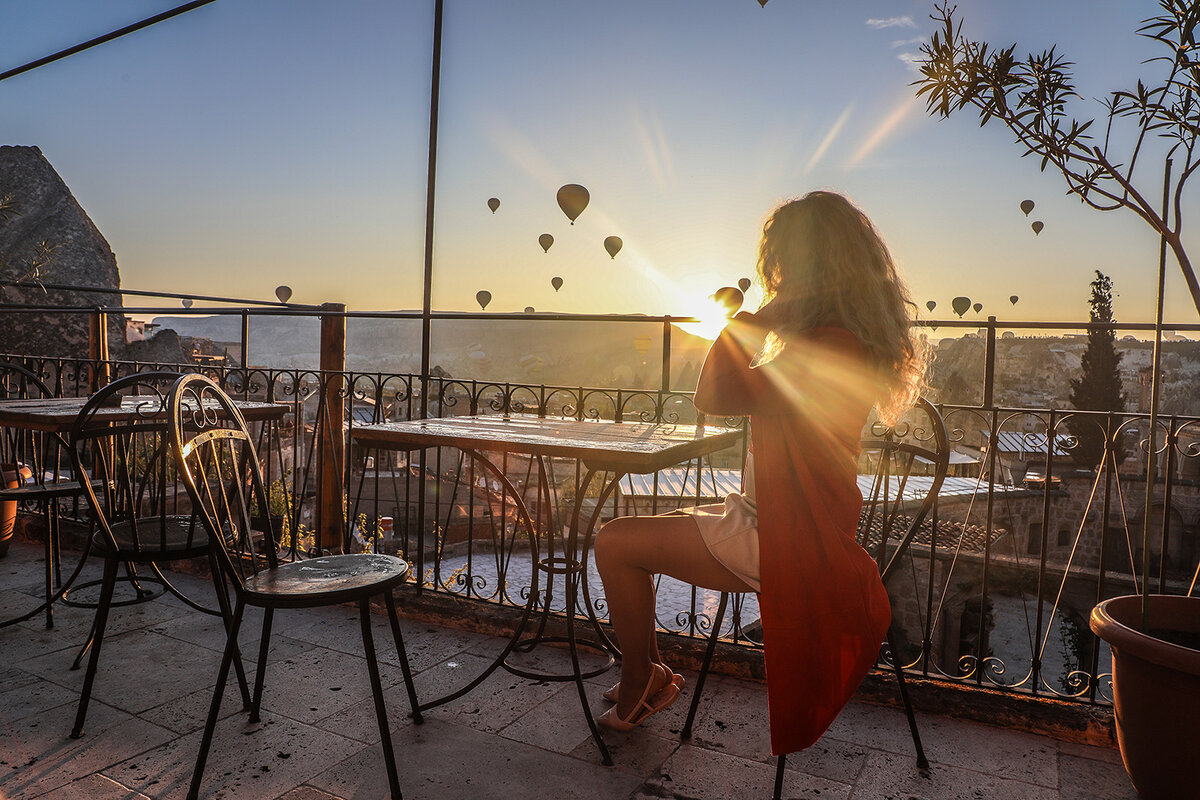
- Cappadocia. Valleys of volcanic "fairy chimneys", cave towns and dawn hot-air balloon flights. From the coast this means an overnight drive or a domestic flight, but the experience outdoes any water park.
- Istanbul. A proper 2–4 day city break: Hagia Sophia, the Blue Mosque, the Bosphorus and the Grand Bazaar. Easy to bolt on before or after the beach week — plenty of direct flights from Poland.
- Blue Cruise. A multi-day gulet trip along the Lycian coves from Fethiye, Göcek or Marmaris — a way to see coastline the beach itself can't reach.
Quick comparison of Turkey's resorts
Figures are indicative, for a 7-night trip for two departing Warsaw. The key columns are the sea, the beach and the transfer — these do more to shape the holiday than anything else.
| Resort | Sea | Beach | Who is it for | Transfer | 7 nights / 2 people |
|---|---|---|---|---|---|
| Antalya | Mediterranean | Sand (Lara), pebble (Konyaaltı) | Town, day trips | 20–40 min | PLN 4,500–12,000 |
| Belek | Mediterranean | Wide sand | Premium, families, golf | ~40 min | PLN 6,000–20,000 |
| Side | Mediterranean | Sand | Formula + antiquity | ~1 hr 15 min | PLN 3,500–9,000 |
| Alanya | Mediterranean | Sand with pebble | Budget | 2–2.5 hrs | PLN 3,000–7,000 |
| Kemer | Mediterranean | Pebble | Mountains, snorkelling | 40–70 min | PLN 3,500–8,500 |
| Fethiye and Ölüdeniz | Mediterranean | Pebble, lagoon | Views, paragliding | ~1 hr | PLN 4,000–9,000 |
| Kaş and Kalkan | Mediterranean | Platforms, coves | Diving, boutique | 2–2.5 hrs | PLN 4,500–10,000 |
| Sarigerme | Mediterranean | Dark sand | Families, short transfer | 15–30 min | PLN 4,000–9,500 |
| Marmaris | Aegean | Fine pebble | Nightlife, cruises | ~1.5 hrs | PLN 3,500–8,500 |
| Bodrum | Aegean | Bays, platforms | Marina, clubs, style | 20–50 min | PLN 4,500–14,000 |
| Kuşadası | Aegean | Sand | Ephesus and the beach | ~1.5 hrs | PLN 3,500–8,000 |
| Didim | Aegean | Fine sand | Budget, children | ~1.5 hrs | PLN 3,000–7,000 |
| Çeşme | Aegean | White sand, bays | Kiting, local crowd | ~1.5 hrs | PLN 5,000–13,000 |
By profile, briefly: young children and gentle sand — Belek, Side, Sarigerme and Didim. Tight budget — Alanya and Didim. Maximum formula for the money — Side and Belek. Clear water and mountains — Kemer. Views and activities — Fethiye, Kaş. Style, marina and nightlife — Bodrum and Marmaris. Antiquity alongside the beach — Kuşadası and Side. And a general rule: the further a resort sits from the airport, the cheaper the package — but the more of your holiday the road eats up both ways. 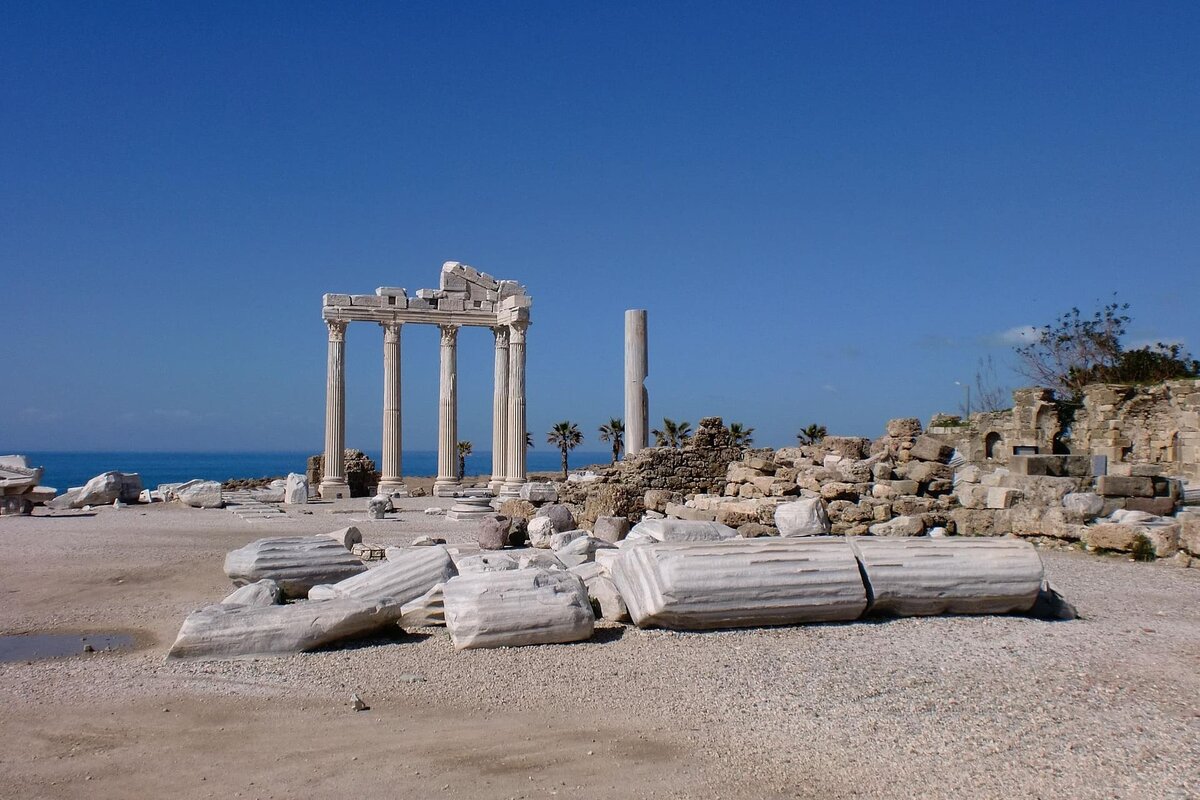
Pre-booking checklist:
- Choose the sea first: the Mediterranean is warmer with a longer season; the Aegean is cooler, windier, and easier on the heat. That decides your month too.
- Check the beach type at the specific hotel: in Kemer and around Bodrum it's more often pebble or a platform than sand — a real difference for small children.
- Add up the transfer honestly: Alanya and Kaş run 2–2.5 hours each way from the airport, and after a night flight the first day is effectively lost.
- Read the all-inclusive contents at the hotel itself: "ultra", "24h" and "soft" aren't standardised, and identical labels can mean very different things.
- Look at June and September: the sea is just as warm, prices run 25–40% below August, and the heat is far more manageable.
- Carry a physical document at the border: a passport or plastic Polish ID card — the mObywatel app isn't accepted for border checks.
Common mistakes:
- Choosing a resort by the tour price alone, without checking the map. A cheap package to Alanya and a pricier one to Belek often differ chiefly in a two-hour transfer and beach type, not hotel quality.
- Booking Kemer for a sandy beach. Expect pebble and often a steep entry — that's the nature of this stretch of coast, not a flaw in a specific hotel.
- Taking July–August on the Mediterranean coast with small children. +36–38°C in Alanya and Side means you can really only be outside morning and evening; June and September give the same sea without it.
- Expecting calm on the Aegean. The meltemi blows nearly every summer day: it saves you from the heat, but it also raises a chop on open beaches and some boat trips get cancelled.
- Assuming Bodrum and Çeşme are budget resorts. These cater to Turkey's own affluent domestic market, prices sit closer to European levels, and the familiar ultra formula is scarce.
- Planning the Black Sea as a beach holiday. The water tops out at +22–24°C at best, and rain is possible all summer — this is a destination for mountains and scenery, not swimming.
Entering Turkey: nationality decides, not where you live
Turkey belongs to neither the EU nor the Schengen Area, so a Schengen visa or a Polish residence permit doesn't by itself grant entry: what matters is your nationality and passport. Check the rules for your specific document.
- Ukrainian citizens: visa-free entry for up to 90 days. The passport must be valid for the whole trip; border officers may ask for a return ticket and proof of accommodation.
- Belarusian citizens: visa-free entry for up to 30 days under a bilateral agreement. A Polish residence permit has no bearing on Turkish entry rules, either way.
- Polish and other EU citizens: visa-free entry for up to 90 days on a passport or a plastic national ID card. One important detail: the mObywatel app is not accepted at the border — a physical document is required.
- General note: an accommodation tax is added to the cost of staying in Turkey, usually already built into a package tour's price. Entry rules and charges change, so confirm the current requirements with your tour operator or official sources before booking.
The verdict
So which sea and which resort should you choose?
If you want the warmest sea and the longest season, it's the Mediterranean coast: Side and Belek for families and the formula, Alanya to save money, Kemer for clear water and mountains, Antalya if you want a city and short transfers. If you handle heat badly, go Aegean: Kuşadası for beach plus Ephesus, Didim for budget sand, Bodrum for style and nightlife, Çeşme for wind and kiting. For scenery and activities, the Lycian coast: Fethiye with Ölüdeniz, Kaş and Kalkan. And save the Black Sea for when you want mountains, tea and cool air rather than a beach.
One last tip:
Don't default to August out of habit: in June and September the Mediterranean sea is just as warm, at +26–27°C, while prices run a quarter to a third lower. And count the journey as well as the tour price: two hours of transfer each way is, in effect, a day of the holiday you've already paid for.

 Holidays


 Last minute
 Hotels


 Blog
Blog